In this post

Florence is a wonderful place for shoe shopping and shoe lovers, simply because of the extraordinary history that this fashion item has in this city. People have been buying shoes in Florence for more than seven hundred years.
Twice a year, in January and June, the menswear fair Pitti Uomo takes over the Fortezza da Basso. It has been running since 1972. For those few days the streets near the station fill with buyers in very good suits. Street-style photographers crouch on the pavement, and plenty of their shots stop at the ankle. Double monks, suede loafers, the odd pair of bespoke boots worn without socks in January. It's a good week to people-watch in Florence and a bad one to look for a hotel room.
Shoes in Florence, street by street
Shoes have been an important fashion item in Florence since the late 1200s, coming in different styles from knee-high boots to Grecian style sandals, and in materials from leather to silk, adorned or simple. The export of Florentine shoes was a roaring business in this period, providing work to the 2,800 cobblers and shoemakers in the city – five hundred of these alone on the Oltrarno street of Via Romana. The streets of Via dei Pepi, Borgo Allegri and Via Verdi in the Santa Croce area were also home to a concentration of cobblers' shops. Today, some of the city's best commercial shoe shops are concentrated on Via degli Speziali, near Piazza della Repubblica.
Walk down Via Romana now, towards Porta Romana, and nothing tells you about the five hundred shoemakers. The side entrance to the Boboli Gardens gets more attention. So does the odd statue in the piazza by the city gate. It's a giant woman with a block of stone on her head, by Michelangelo Pistoletto. Locals have opinions about her.
Borgo Allegri, over in Santa Croce, has a better story. Vasari says the street took its name from the party that followed Cimabue's Madonna through it. Most historians don't believe a word of it.
Then there's Via dei Calzaiuoli, the straight, crowded run from the Duomo to Piazza della Signoria. The calzaiuoli made hose, not shoes, but close enough. The shoemakers had their own guild, the Arte dei Calzolai. The statue they paid for stands halfway down the same street, on the outside of Orsanmichele. It's Saint Philip, by Nanni di Banco. Hardly anyone on the way to the Signoria looks up at him.
Made to measure, still
Shoes were regularly handmade and made to measure until the mid-1800s, when factories came into play. Florence, however, continues the art of handmade, made-to-measure shoes, particularly for men, with several workshops still dotted around the city. Pop into Roberto Ugolini's workshop near Piazza Santo Spirito or Saskia in Via Santa Lucia for some insight into handmade leather shoes. Or visit the Salvatore Ferragamo Museum for this modern fashion giant's story and some famous shoes.
Santo Spirito is the square with the plain, unfinished church front. It has morning stalls, and bars that fill up after dark. Ugolini has worked in the streets around it for decades. From outside you would never guess that shoe collectors in Tokyo know his name. Until 1995 he still did ordinary repairs. Then he dropped them and made only bespoke shoes.
Saskia came from Berlin and worked as Stefano Bemer's first assistant. She opened her own place on Via Santa Lucia in 2000. She makes men's shoes, nothing off a shelf. She has told interviewers that the old artisans nearby took a while to believe she was there to stay.
These are not shops for picking up a pair on the way to dinner. Bespoke shoes in Florence mean measurements, a wooden last shaped to your foot and several fittings over months.
The shoemaker of the stars
Salvatore Ferragamo began his extraordinary shoe career as a teenage apprentice. Originally from the south of Italy, Ferragamo made Florence his home in 1927 after an enormously successful stint in Hollywood granted him his nickname, “shoemaker of the stars.” From Florence, where he could much more easily find the best materials and skilled artisan cobblers to work alongside him, Ferragamo continued making shoes for American cinema stars from Audrey Hepburn to Marilyn Monroe.
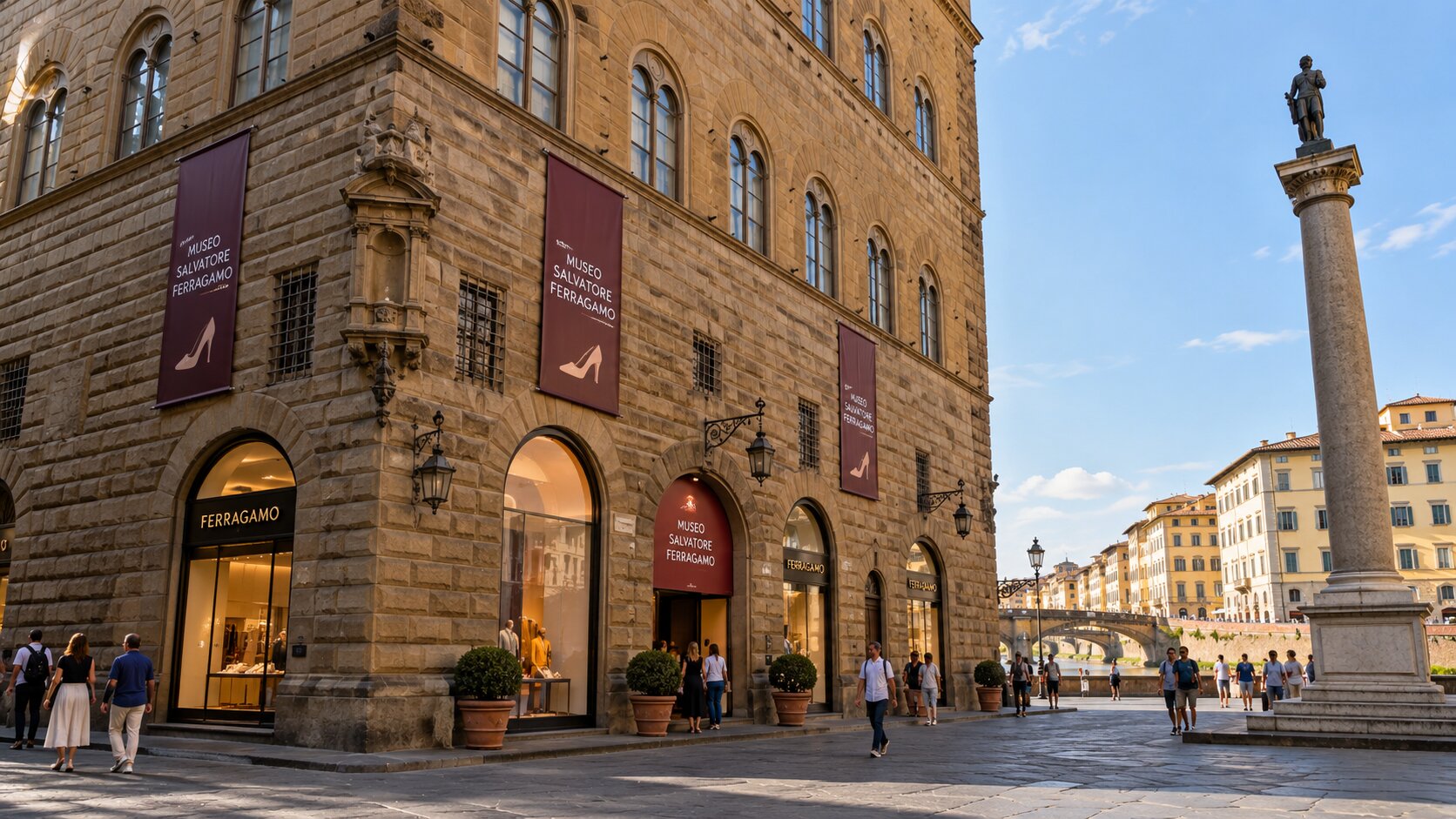
The Ferragamo Museum is housed in the grand Palazzo Spini Feroni on Via Tornabuoni, where the Ferragamo store and bottega has been since the 1930s. The collection covers Salvatore Ferragamo's creations and projects from 1927 to 1960, forming a remarkable archive of 20th-century fashion.
Ferragamo also cared a great deal about the mechanics of the foot. In Los Angeles he took anatomy classes at the University of Southern California. He wanted to understand how the body's weight lands on the foot. Much of his work on shoe construction grew from that, the famous wedge included.
The museum entrance is actually round the side, on Piazza Santa Trinita. It faces the tall granite column in the middle of the square, a few steps from the bridge. Ferragamo bought the whole palazzo in 1938, which tells you how well his cork wedges sold. The exhibitions change, so a given pair may not be out when you visit. If the 1947 Invisible sandal is on show, find it. The upper is clear nylon thread, more or less fishing line. That shoe won him the Neiman Marcus Award.
Speziali, Tornabuoni and the stalls
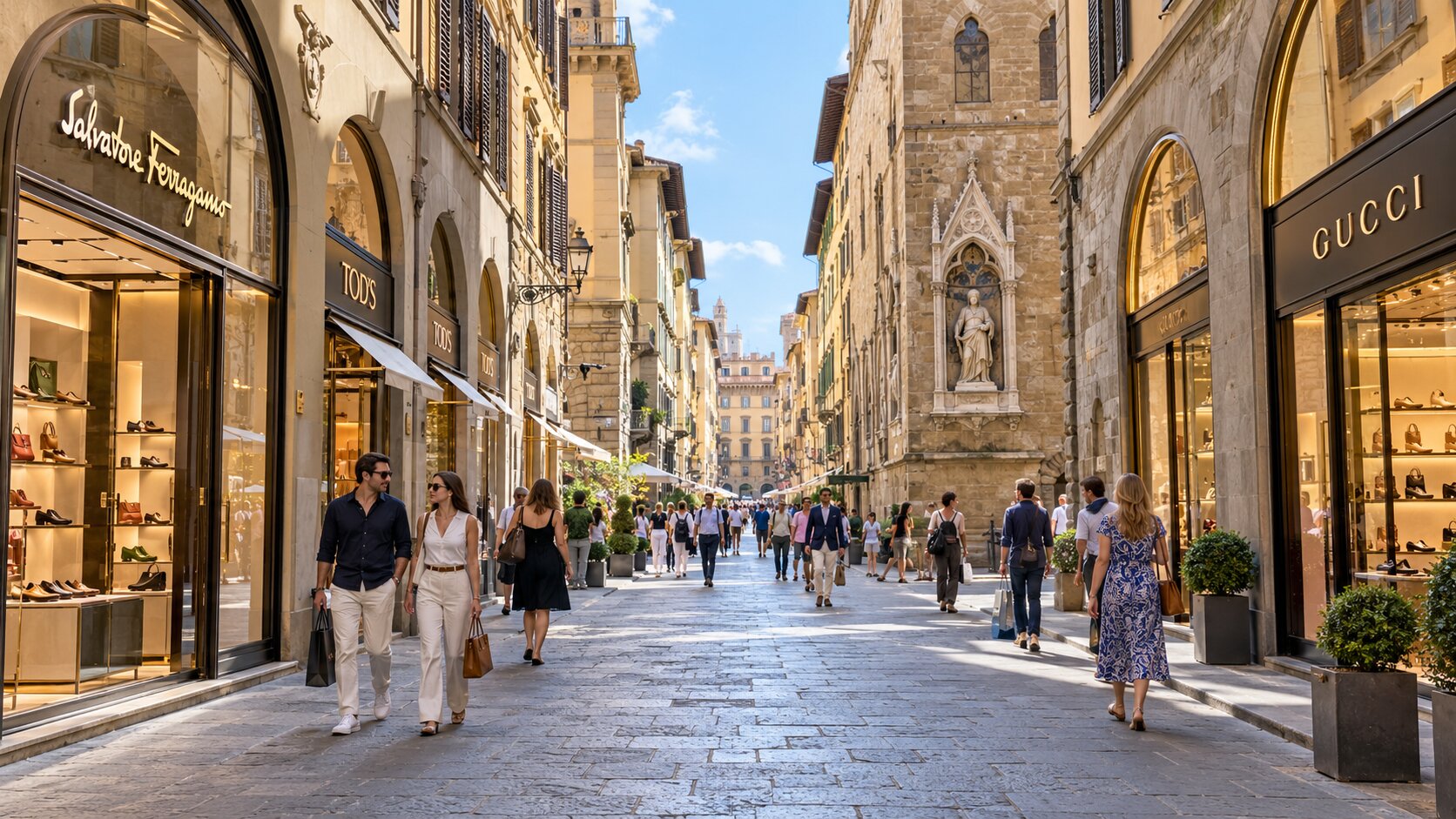
For a pair you can walk out with the same afternoon, Via degli Speziali is still a good bet. Via Tornabuoni works too, if the budget stretches. The speziali were the spice and medicine sellers, so the shoe shops there are newcomers by Florentine standards. Gucci is a Florentine name as well. More people know it for bags than for the horsebit loafer of 1953.
The stalls around San Lorenzo sell far more belts, bags and jackets than shoes. It's worth looking closely before paying, and our piece on leather in Florence goes into what to check.
Shoes in Florence are also something people repair. Look out for small shops with a calzolaio sign over the door. Most are a single room with a bench, a stack of soles and often a key-cutting machine in the corner. You'll find them in residential streets more than on the main tourist routes. Plenty of locals stick with the same one for years.
Across the river, the Oltrarno still has shoemakers, bookbinders and gilders behind small doors around Santo Spirito and Via Maggio. They are easy to miss on your own. A private Florence tour with artisan workshops stops in this part of town. The guide explains what's going on inside.
Tanneries downriver, around Santa Croce sull'Arno, supply a lot of the leather in Tuscan shoes. That's on the way to Pisa. Pisa is the last stop of The Best of Tuscany day trip, after Siena, a winery lunch in the Chianti hills and San Gimignano. Siena has free time built in, if the shopping bug follows you out of Florence.
Roberto Ugolini
Via de' Michelozzi, 17r
Saskia
Via Santa Lucia, 24r
Salvatore Ferragamo Museum
Via Tornabuoni, 2r