In this post
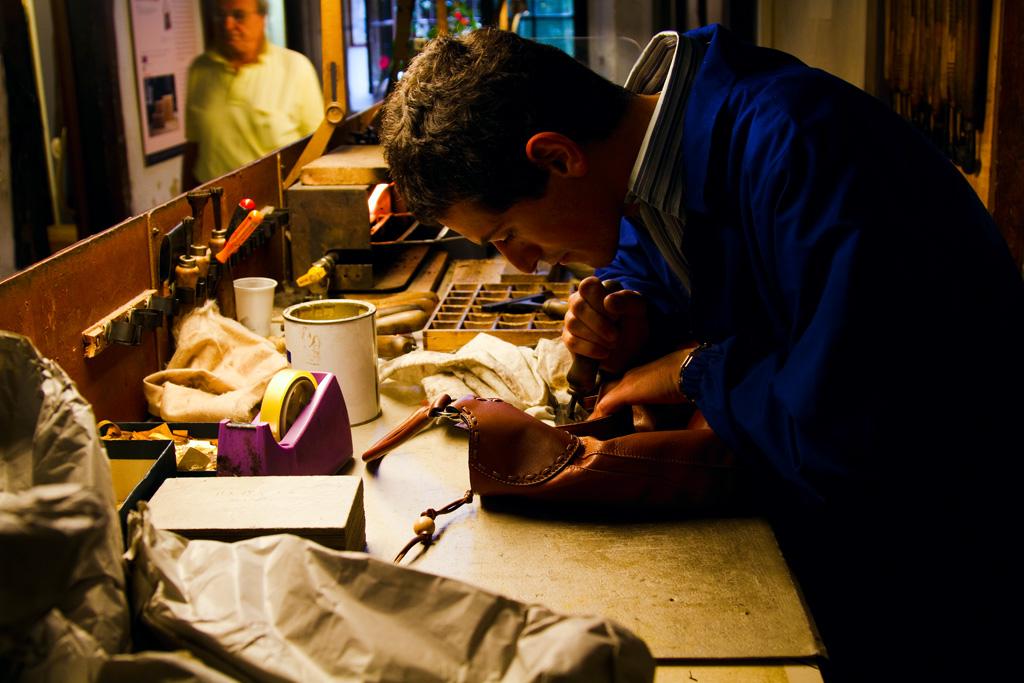
Few crafts define this city the way leather does. Walk through Santa Croce and the street names alone tell you something: Via dei Conciatori, Via delle Conce, names that have outlasted the workshops they were named for by centuries. Leather in Florence isn't a souvenir-shop gimmick dreamed up for tourists. It's one of the oldest working trades the city has, and it's still very much alive.
A Craft Centuries in the Making
Leather is one of the world's most ancient of traditions, and it certainly has left its mark profoundly on Florence. With street names still dedicated to the old areas (especially Santa Croce) of the leather workers, leather is still very much a part of Florence's commerce, with bags, jackets and gloves still being popular items after centuries.
Gloves, a Florentine Specialty
Leather gloves were popular with 16th century Florentines when, for fashion's sake, short sleeves were all the rage. Women often wore long, soft leather gloves up to their elbows, and eventually gloves, both long and short, became an obbligatory fashion accessory until the 19th century. The making of gloves still is a Florentine specialty, the real ones being still hand stitched, and often lined with cashmere for the colder months.
What made Florentine gloves worth the fuss wasn't just the leather itself but the fit. A well-made glove is shaped closely around the hand rather than simply sewn into a tube, which is part of why a genuinely hand-stitched pair still costs noticeably more than a machine-made one. The skill hasn't disappeared, it's just concentrated in fewer hands than it used to be, passed from one generation of glovemakers to the next inside a handful of workshops rather than spread across dozens.
Bags, Belts and the Tanners of the Oltrarno
Leather bags were traditionally made in the workshops of the Oltrarno and were popular with medieval pilgrims for their long travels, while leather belts were a popular accessory for fashionable Renaissance Florentines. While the "aromatic" tanners of the Middle Ages were traditionally based outside of the town walls, as the city grew larger in the 16th century they were moved even further away from the city. There are still Florentine artisans who work in the traditional way with leather to create bags, belts, shoes and other goods, but beware of the authenticity of the majority of items you find in the markets.
That word "aromatic" is doing some polite work. Tanning leather the old way involved genuinely unpleasant smells, hides soaked and treated in ways that no city wanted upwind of its main streets, which is exactly why the trade kept getting pushed further from the centre as Florence grew. The Oltrarno, on the "other side" of the Arno from the main tourist sights, became the natural home for these workshops for practical reasons as much as tradition, close enough to the city to sell into it, far enough to keep the smell at a distance.
Santa Croce has its own version of this history, tied to its position on the riverbank. Since the 13th century, this was the district where tanneries that needed large quantities of water concentrated, alongside the dyers of Corso dei Tintori and the soap makers of Via dei Saponai nearby. Via delle Conce and Via dei Conciatori, the streets of the tanners, still run just a few steps from the Basilica today, a reminder that this was working, unglamorous industry long before it was anyone's idea of a shopping destination.
Belts followed a slightly different path than bags and gloves. Where a bag needed to survive months on a pilgrim's back, a belt was as much about status as function, and Renaissance Florentines used them to show off buckles, tooling and dyes that signalled wealth as clearly as the fabric they were paired with.
What to Look For When Buying Leather
The gap between a genuine Florentine leather piece and a mass-produced import isn't always obvious at a glance. Real leather has a distinct, earthy smell, quite different from the flatter, more chemical scent of coated synthetic, and it's worth handling a piece before deciding it's the real thing. Price is a rougher but still useful signal too: a piece that's genuinely hand-stitched and hand-finished takes hours of skilled labour to produce, and that labour shows up in the price whether or not the seller explains why. None of this makes a market stall automatically untrustworthy, but a workshop willing to show you how something was made is usually a good sign.
The San Lorenzo street market, spread around the Mercato Centrale, is where most visitors end up first, and it's worth knowing the difference between what's sold there and what comes out of a workshop like the ones in the Oltrarno. Stalls at San Lorenzo can genuinely turn up good bargains, but the same sprawling market also carries plenty of imported goods labelled loosely as "genuine leather", which is a very different claim from being made in Florence by hand. Neither is inherently a trap, they're just different products at different price points, and it helps to know which one you're actually buying before you haggle over it.
The Leather School Behind Santa Croce
To see more, visit the Scuola del Cuoio in Santa Croce, tucked behind the church, where artisans still work at benches lining the old monastery corridors. The school has a documented history worth knowing: it was founded in 1950 by leather craftsman Marcello Gori, together with Silvano Casini, working with the Franciscan friars of the Santa Croce monastery, specifically to teach leatherworking to orphans left by the Second World War. Its first students came from a boys' home in Pisa. Decades later the school is still run by Gori's descendants, and visitors can watch masters and apprentices cutting, stitching and gold-tooling leather using techniques that have barely changed since it opened.
The school didn't escape the city's harder moments, either. When the Arno flooded Florence in November 1966, Santa Croce, being low-lying and close to the river, was among the hardest-hit districts, and the school's workshops were damaged along with the rest of the basilica complex. It recovered, and over the decades its client list grew to include names like the Rockefeller family, the British Royal family and Dwight D. Eisenhower, who is said to have commissioned a leather desk set.
For gloves specifically, Madova on Via Guicciardini is the name most worth knowing: the Donnini family has run it since 1919, and it's often described as the only shop in Europe still exclusively making and selling leather gloves.
Addresses
Scuola del Cuoio, inside Santa Croce church (entrance also on Via San Giuseppe, 5r). Madova, Via Guicciardini 1r, near the Ponte Vecchio.
Beyond the Workshops
An afternoon spent among Florence's leather workshops pairs naturally with a longer day out in the Tuscan countryside. Our Best of Tuscany Day Trip from Florence takes in Siena, San Gimignano, a Chianti winery lunch and Pisa's Leaning Tower, all in a single day from the city. Either way, leather in Florence rewards a bit of curiosity, the difference between a market stall and a workshop bench is usually worth the extra few steps to find out.