In this post
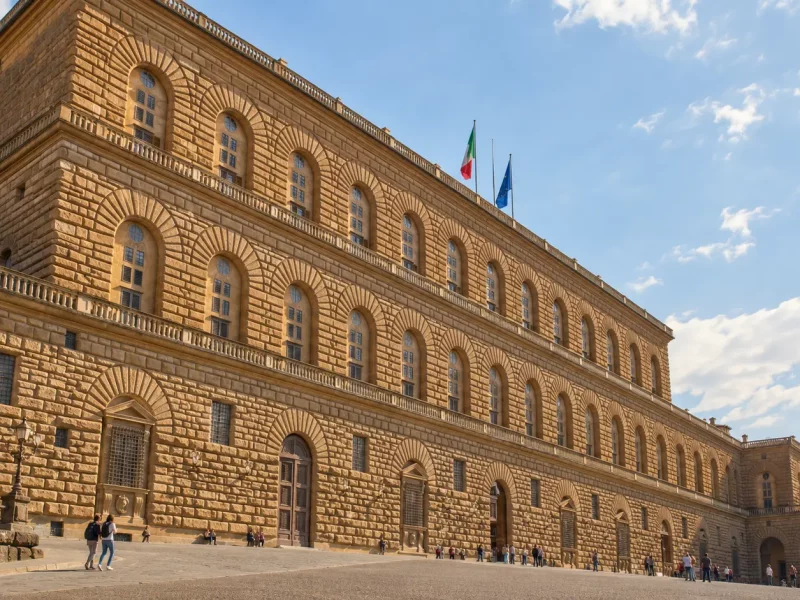
Pitti Palace history starts in 1458, when the banker Luca Pitti began a house on the Oltrarno slope that was meant to look grander than anything the Medici owned. He lost his money and his political standing before it was finished, and in 1549 the Medici bought it from his descendants. Three ruling families lived there over the next four centuries, the Medici, the Habsburg-Lorraine and the Savoy, until the king of Italy handed it to the state in 1919.
Seen from the bottom of Piazza Pitti, the façade looks like one building planned all at once. It isn't. The rough stone wall you see is the work of at least four different centuries, and it's much easier to read once you know the order things were added. The Oltrarno section of our Essential Florence Walking Tour stops in front of the palace (we don't go inside), and that's usually the moment the guide untangles who built which part, and why a merchant's house ended up as a royal residence.
Luca Pitti's rival palace
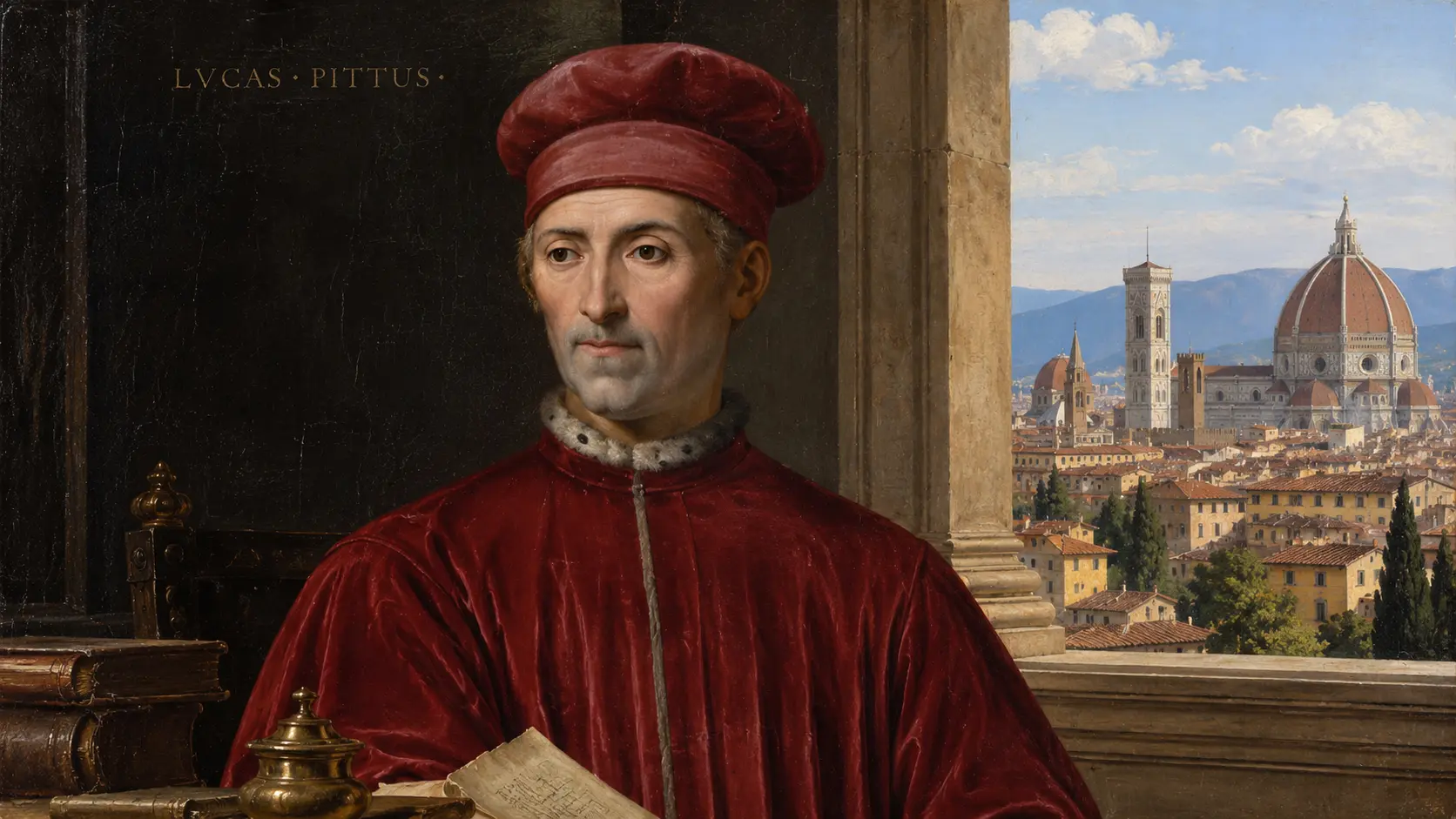
Luca Pitti was a merchant banker and, for years, one of Cosimo de' Medici's most useful allies. In 1458 he led the political manoeuvre that kept Cosimo's faction in control of the government, and that same year he started building. The Florentine story is that he wanted his windows to be as big as the main door of the Medici palace on Via Larga. Probably a legend. The windows are huge, though.
The design is traditionally credited to Brunelleschi, which is awkward, because Brunelleschi died in 1446. Most historians give the actual building to Luca Fancelli, who had trained under him. What went up was far smaller than the palace today: three doorways and two rows of seven windows, faced in pietraforte, the brown sandstone quarried from the hill right behind it.
Then it went wrong. Cosimo died in 1464, and Luca sided with the families who wanted to push Cosimo's son Piero out of power. The plot failed. Piero didn't send anyone to the scaffold over it, but Luca owed the Medici bank a great deal of money and Piero made sure he felt it. Work on the palace stopped. Luca died in the early 1470s with the building half done, and his family went on living in the unfinished shell for almost eighty years.
Eleonora of Toledo buys the house
In 1549 Buonaccorso Pitti, a descendant of Luca, sold the palace to Eleonora of Toledo for 9,000 florins. Eleonora was the Spanish wife of Duke Cosimo I de' Medici and had grown up at the court of Naples. She also had her own money, and the purchase is usually described as hers rather than her husband's.
The Medici turned the place into something else entirely. Niccolò Tribolo started laying out a garden on the hill behind, which became the Boboli Gardens. The old quarry that had supplied Luca's stone was reshaped into the amphitheatre you still see from the back windows. Bartolomeo Ammannati, whose wife Laura Battiferri was a poet and a close friend of Eleonora, designed the big courtyard that links the palace to the garden, with that heavy banded stonework that makes the columns look like they've been stacked from rings.
Eleonora didn't see much of it. She died in 1562, while the work was still going on.
The corridor and the balcony in Santa Felicita
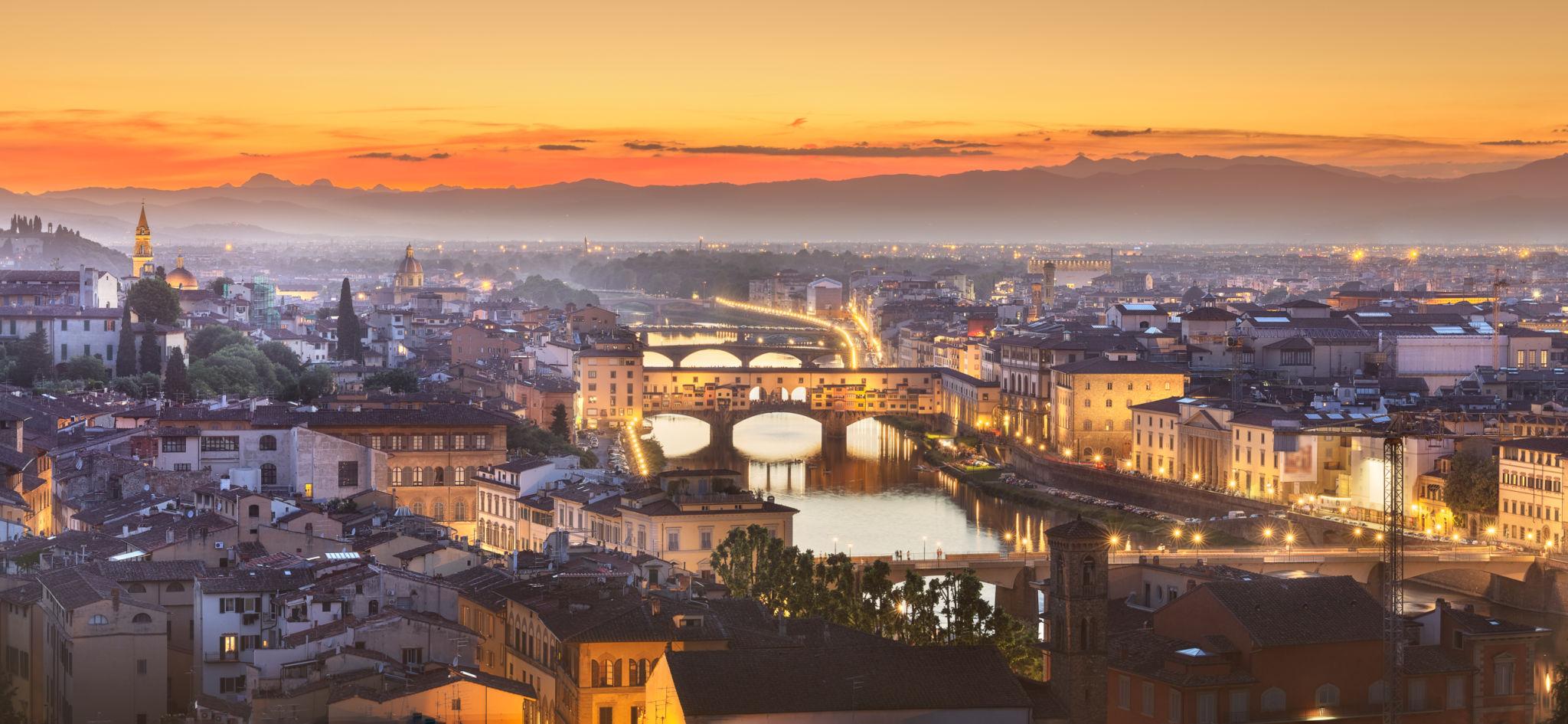
In 1565 Cosimo I had Giorgio Vasari build an enclosed passage from Palazzo Vecchio, through the Uffizi offices, over Ponte Vecchio and across to the Pitti. It took about five months and was finished in time for the wedding of Cosimo's son Francesco to Joanna of Austria. The family could now walk from the seat of government to their home without setting foot in the street.
The corridor runs for roughly 750 metres. It bends around the Mannelli tower at the south end of the bridge, because the Mannelli family refused to let it go through. Further on it crosses the front of Santa Felicita, where the Medici had a private balcony looking down into the church so they could hear Mass without sitting among everyone else. A few decades later Ferdinando I moved the butchers off Ponte Vecchio and gave the shops to goldsmiths, which is why the bridge still sells jewellery. You can read more about the passage in our piece on the Vasari Corridor, written while it was closed for restoration. It reopened in December 2024, and the route now runs one way, from the Uffizi to a door in the Boboli Gardens next to the Buontalenti Grotto.
Why is the façade so long?
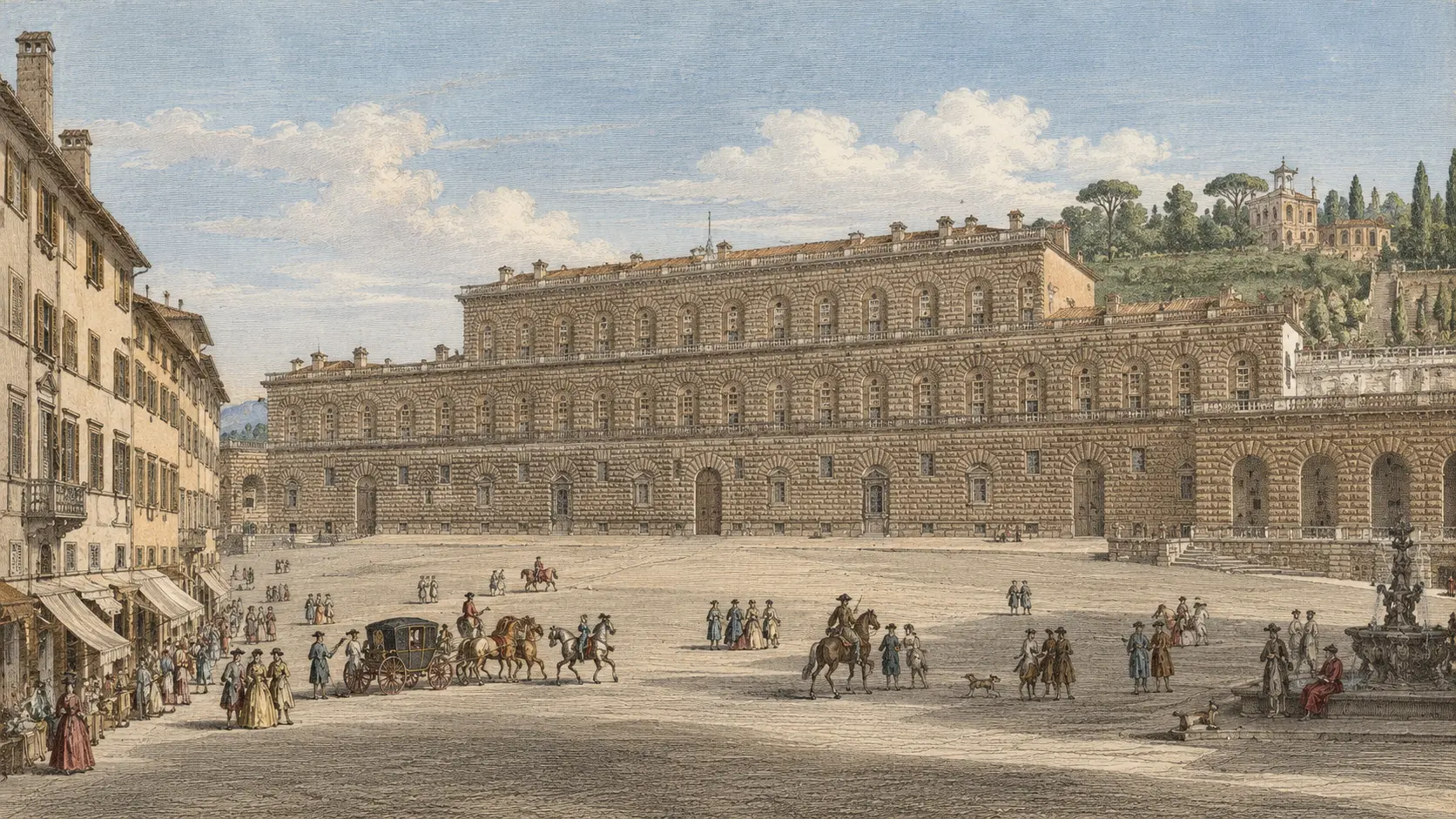
Because it kept growing for two hundred years. In 1616 the grand duke held a competition to extend the main front, and Giulio Parigi won it. Work on the north end began in 1618; his son Alfonso started the south end in 1631. The two projecting wings with terraces at either side of the square, the "rondò", came later still, under the Habsburg-Lorraine. Those additions roughly tripled the size of the piazza in front.
Standing in Piazza Pitti, it's hard to see where Luca's house stops and the grand-ducal palace begins, since every phase reused the same rusticated stone on purpose. A guide can point out the joins. The square itself also slopes steeply up to the entrance, so the palace looks even bigger than it is when you arrive from Via Guicciardini.
Lorraine rulers, Napoleon and a king in residence
The last Medici grand duke, Gian Gastone, died in 1737. Tuscany passed to Francis Stephen of Lorraine, and the Pitti went with it. Before that happened, his sister Anna Maria Luisa signed the Family Pact, which tied the Medici collections to Florence for good. That one document is the reason the paintings never left the city, something our Uffizi Gallery guide touches on from the other side of the river.
The Lorraine converted the palace's winter apartments into a picture gallery, the Palatine Gallery, and opened it to the public in 1828. They hung the paintings frame to frame, in the crowded seventeenth-century way, and that arrangement has largely been kept. It holds the largest group of Raphaels anywhere in Florence. In 1796 Grand Duke Ferdinand III received a young General Bonaparte in the White Room, the Sala Bianca, three years before French troops took the city.
After Italian unification, Florence was the capital of the new kingdom from 1865 to 1871, and Victor Emmanuel II lived at the Pitti during those years. His grandson, Victor Emmanuel III, gave the palace, the square and the Boboli Gardens to the Italian state in 1919.
Pitti Palace history on a Florence walk
Today the building houses the Treasury of the Grand Dukes, the Palatine Gallery with the Royal and Imperial Apartments, the Gallery of Modern Art and the Museum of Costume and Fashion. Going through all of it takes most of a day, and the Boboli Gardens another few hours on top.
The Essential Florence Walking Tour is a different thing. It's three hours on foot, starting at 9am in Piazza della Repubblica in front of Caffè Gilli, and it covers the city from its Roman street grid to the Oltrarno. On the south bank you see the Pitti from the square, Santa Felicita, the Vasari Corridor from the street and Via Maggio, Florence's antique dealers' street, before crossing back. The guide ties the Pitti back to the other palaces on the route, Strozzi and Rucellai on the far bank, which were built by families playing the same game as Luca Pitti, with better results. There's a gelato stop too. If you plan to visit the Palatine Gallery or Boboli on another day, it helps to have seen the outside with someone who can tell you whose money paid for which wall.