In this post
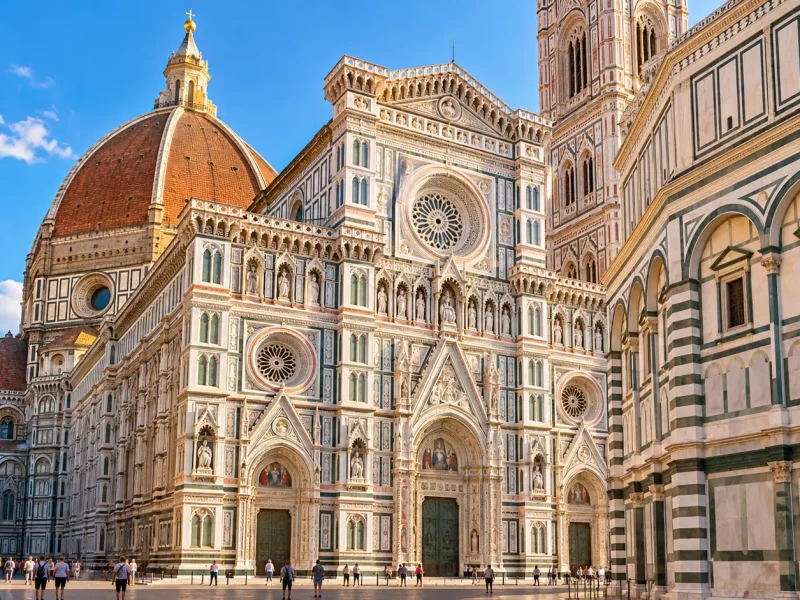
A private Florence Duomo tour with Walkabout lasts about three hours and starts at 9am. First you walk Piazza del Duomo with your own guide. Then you climb the 463 steps of Brunelleschi's dome with skip-the-line tickets and finish on the terrace at the top.
That's the short version. The longer one is that the square holds far more than the cathedral. Most visitors only notice two things there: the façade and the queue.
The front is the newest part
Builders only finished the white, green and pink marble front of Santa Maria del Fiore in 1887. For roughly three centuries the cathedral had no proper façade at all. In 1587, under Grand Duke Francesco I de' Medici, the city knocked down the half-built medieval front. Then nobody could agree on what should replace it. It took a long competition in the nineteenth century before Emilio De Fabris got the job. His front picks up the colours of the Baptistery and the bell tower: white Carrara marble, green stone from Prato and red from the Maremma.
Brunelleschi's workers had closed the top of the dome in 1436, four and a half centuries earlier.
What you see on a private Florence Duomo tour before the stairs
The walk around the square covers the cathedral and its façade, the Baptistery from the outside and Giotto's bell tower. It also takes in the Loggia del Bigallo and the Misericordia. In the Middle Ages each of them had a different owner. The wool guild ran the cathedral works and the cloth merchants' guild looked after the Baptistery. The two charities on the corners belonged to lay brotherhoods.
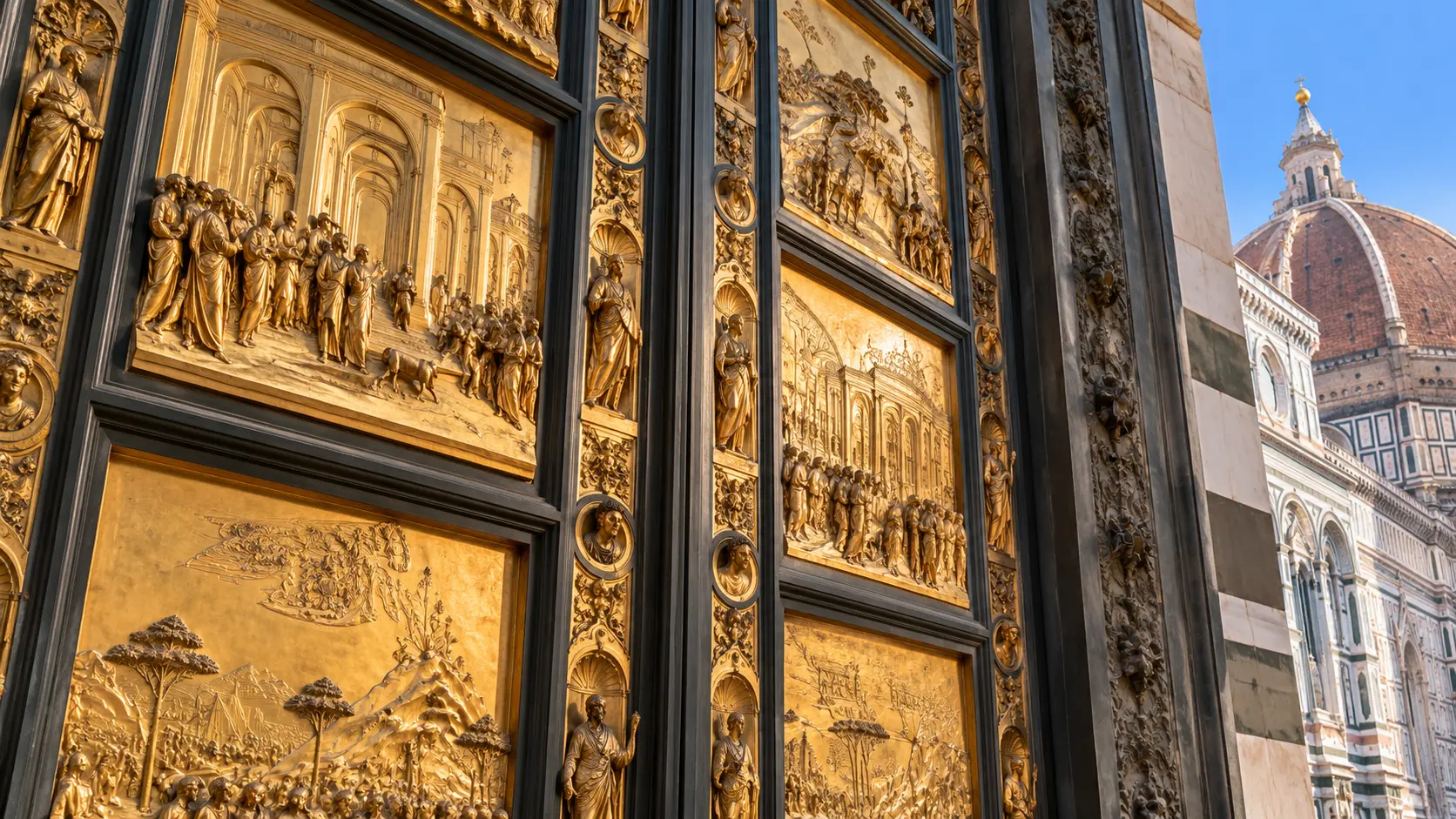
The Baptistery of San Giovanni is the oldest building on the square. For centuries Florentines brought their babies here for baptism, and Dante's parents did the same. It was the city's spiritual centre long before the cathedral went up. Its east doors are Lorenzo Ghiberti's Gates of Paradise. The doors on the building today are copies, and the gilded originals now sit in the Museo dell'Opera del Duomo. If the doors brought you here, our article on the Gates of Paradise tells how the copies came about.
Giotto designed the bell tower in 1334 and died three years later. Andrea Pisano and then Francesco Talenti finished it. The hexagonal reliefs low down on the tower show trades like weaving, navigation and farming. They're copies too.
Two charities on the corners
Most groups walk past these two buildings without stopping. The Loggia del Bigallo is a small Gothic loggia from the 1350s, facing the Baptistery. Lost and abandoned children sat under its arches so that their families could come and claim them. Inside, the small Bigallo museum keeps a 1342 fresco of the Madonna della Misericordia. At her feet lies the oldest known view of Florence, with the Baptistery already in place.
Across the square stands the Misericordia, a lay brotherhood founded in the thirteenth century. Its members cared for the sick and buried the dead. For centuries they wore black hooded robes, so nobody knew who was doing the charity. The Misericordia still runs ambulances and volunteer services from the same corner of the square.
On our Private Florence Duomo Tour with Dome Climb nobody else joins the group, and the guide follows your interests. You can stay longer at the bell tower reliefs or skip the Medici altogether. You can also ask why a charity ended up with its offices opposite the cathedral. You get headsets as well, since by mid-morning the square gets loud.
Up to the Last Judgment
The climb starts from a side door on the north flank of the cathedral, the Porta della Mandorla. Dome tickets come with a time slot, and you line up at the door about ten minutes before it. The first stretch is a stone spiral staircase inside the walls. It's narrow and fairly dark, with little to look at exept the person ahead.
Then the stairs open onto a walkway around the inside of the dome, high above the cathedral floor. Above you is the Last Judgment, about 3,600 square metres of fresco. Giorgio Vasari started it in 1572, and Federico Zuccari finished it in 1579 after Vasari's death. Vasari worked in true fresco on wet plaster. Zuccari switched largely to painting on dry plaster, and restorers in the 1980s and 90s could see the difference clearly.
From the nave the painting reads as a pattern of colour. From the walkway the figures are enormous. The lower band shows the damned and the devils, close enough to make out faces. Zuccari painted a few real people into it, himself included, and your guide can point them out.
Inside the brickwork
Next you enter the gap between the two shells of the dome. Brunelleschi built two, a heavy inner dome and a lighter outer one, tied together. The stairs run in the space between them, right past the brickwork. Look at the walls and you'll spot the herringbone pattern. Some bricks stand on end at intervals in a zigzag. They held each new ring in place while the mortar set.
The whole dome went up between 1420 and 1436 without a wooden centring. That's the huge timber frame that normally held up a dome during construction. Before that, the cathedral had stood with an open crossing for decades. Florence spent those years arguing about whether anyone could build the dome at all. Brunelleschi also designed his own hoisting machines, including an ox-driven hoist, to lift the materials.
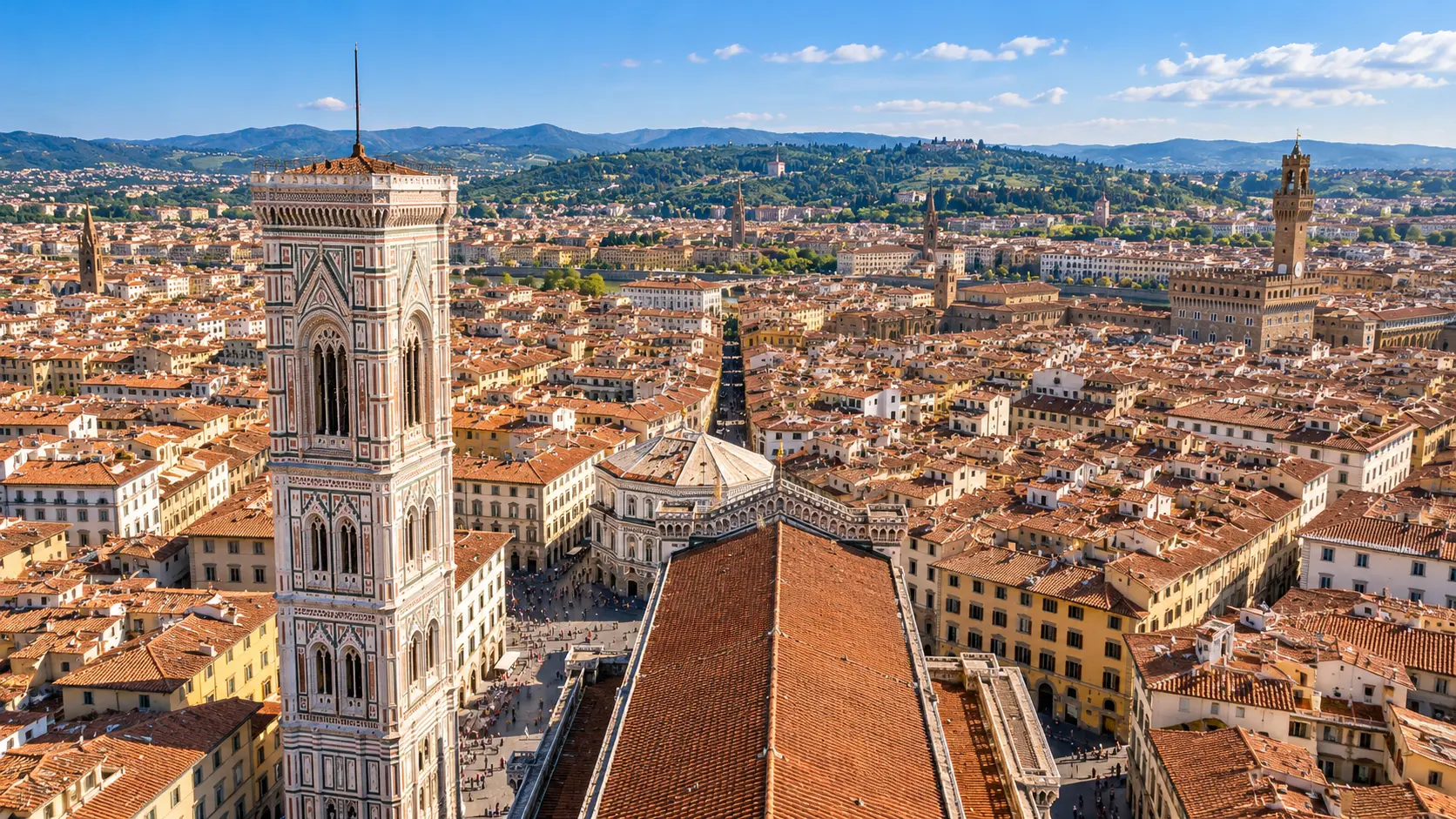
The last section is the steepest. A tight staircase follows the curve of the dome and brings you out at the base of the lantern. From there you see the whole city. Giotto's tower sits just below you. Further off are Palazzo Vecchio's tower, the long roof of Santa Croce and San Miniato on its hill across the Arno. On a clear day you can follow the hills north toward Fiesole.
Back down in the square, walk round behind the apse and look at the paving. A round white marble disc sits in it, easy to miss. It marks where the gilded copper ball from the lantern landed in 1601, after lightning knocked it off. The ball up there now is a replacement.
Is the dome climb hard?
There is no lift. The steps are uneven in places and the passages are narrow and low. In summer it also gets warm between the shells. You need to be in good physical condition. The climb isn't suitable for people with vertigo, claustrophobia or heart problems, or for pregnant women. The tour isn't accessible for wheelchair users.
A few practical notes
Everyone, men and women alike, must cover knees and shoulders to enter the cathedral. Medium and large bags, backpacks, long umbrellas and selfie sticks can't go up the dome. You can leave them at the free luggage storage the Opera del Duomo runs at Piazza Duomo 38/r. Since 1 March 2025 each dome ticket carries the visitor's name, so bring an ID document. The tickets skip the line, but on very busy days you may still wait a little at the climb entrance. The private Florence Duomo tour also needs at least two guests to book.