In this post
Yes, you can see Pisa and Siena in one day from Florence. You need a car and a long day. Count on about twelve hours: Siena in the morning, lunch at a Chianti winery, a stop in San Gimignano and Pisa in the late afternoon. You see the highlights of both cities, not every corner.
Siena is about 70 km south of Florence and Pisa about 85 km west. The road between them runs for more than 100 km across the middle of Tuscany. On a map the day is a triangle with Florence at one corner.
Is Pisa and Siena in One Day Too Much?
For most first-time visitors, no. It's a full day, and you won't get to know either city well. But you do get the core of both, plus the countryside in between. That countryside is most of what people picture when they say "Tuscany".
The hard part is the link between the two cities. There's no direct train from Siena to Pisa. The two regional lines meet at Empoli. By public transport that means a change, a wait on the platform and a lot of looking at your watch.
Our private Tuscany tour to Pisa, Siena and San Gimignano does the whole loop by road. A guide meets you at your accommodation in Florence. You travel in an air-conditioned van, and there's no coach group to wait for at each stop.
Still deciding whether one city would be enough? Our comparison of Siena vs Pisa looks at how differently the two feel. This article assumes you want both.
Siena in the morning
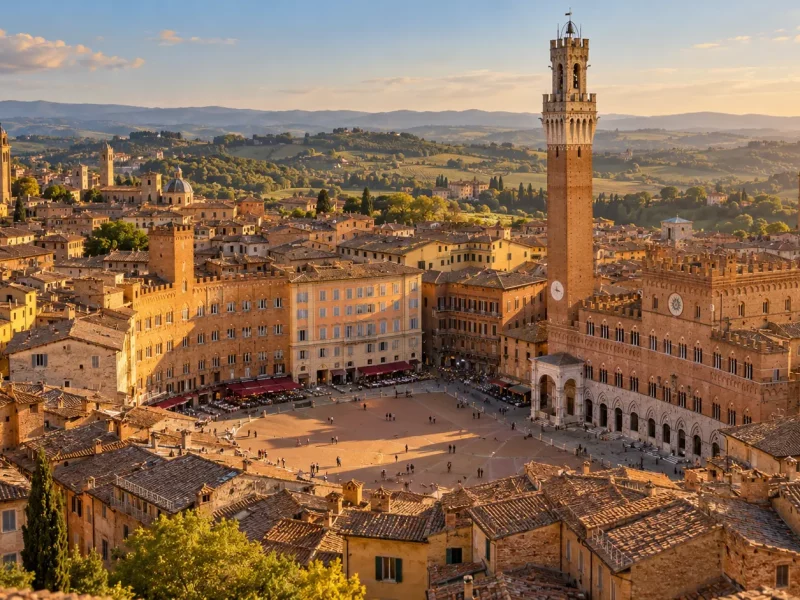
Siena sits across three ridges. Its streets climb and drop far more than a photo of Piazza del Campo would suggest, so wear shoes you can walk in.
The Campo is where the guide stops to explain the Palio. The city runs the race twice a year, on 2 July and 16 August. Riders do three laps of the square on a layer of packed earth over the stone. Ten of the city's seventeen contrade ride each time, and the losers take it personally for months.
The Torre del Mangia rises above the square. It takes its name from its first bell-ringer, Giovanni di Balduccio. People called him Mangiaguadagni, "eat-the-profits", because he spent his pay so fast.
A few minutes' walk away stands Palazzo Salimbeni, home of Monte dei Paschi di Siena. The bank dates from 1472 and most sources call it the oldest bank still operating. Most visitors walk straight past the building without knowing.
The contrade on every corner
You'll see the contrade everywhere once you know to look. Every district puts its animal or symbol on small plaques at street corners. You pass a snail on one corner, and a few streets later a she-wolf or a caterpillar. Around the races, the contrade's flags fill the streets as well.
Each contrada also has its own small fountain, the fontanina. On the contrada's feast day, families bring children born in the district for a second baptism there. It's a civic ceremony in the contrada's colours, and it has nothing to do with the church one. Your guide will probably point out a fontanina or two on the way to the Duomo. If you pass the Onda fountain, look for the dolphin.
Then comes the Duomo, with its black and white stripes and its inlaid marble floor. Inside is the Piccolomini Library with Pinturicchio's frescoes. The cathedral keeps much of the floor covered for protection. It only uncovers all of it for some weeks of the year, so what you see depends on the date. During a religious service, the visit moves to Santa Maria della Scala. This old hospital opposite the cathedral is now a museum.
There's usually time for a coffee on the Campo before getting back in the van.
Lunch on a Chianti estate
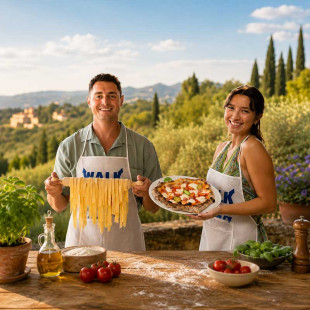
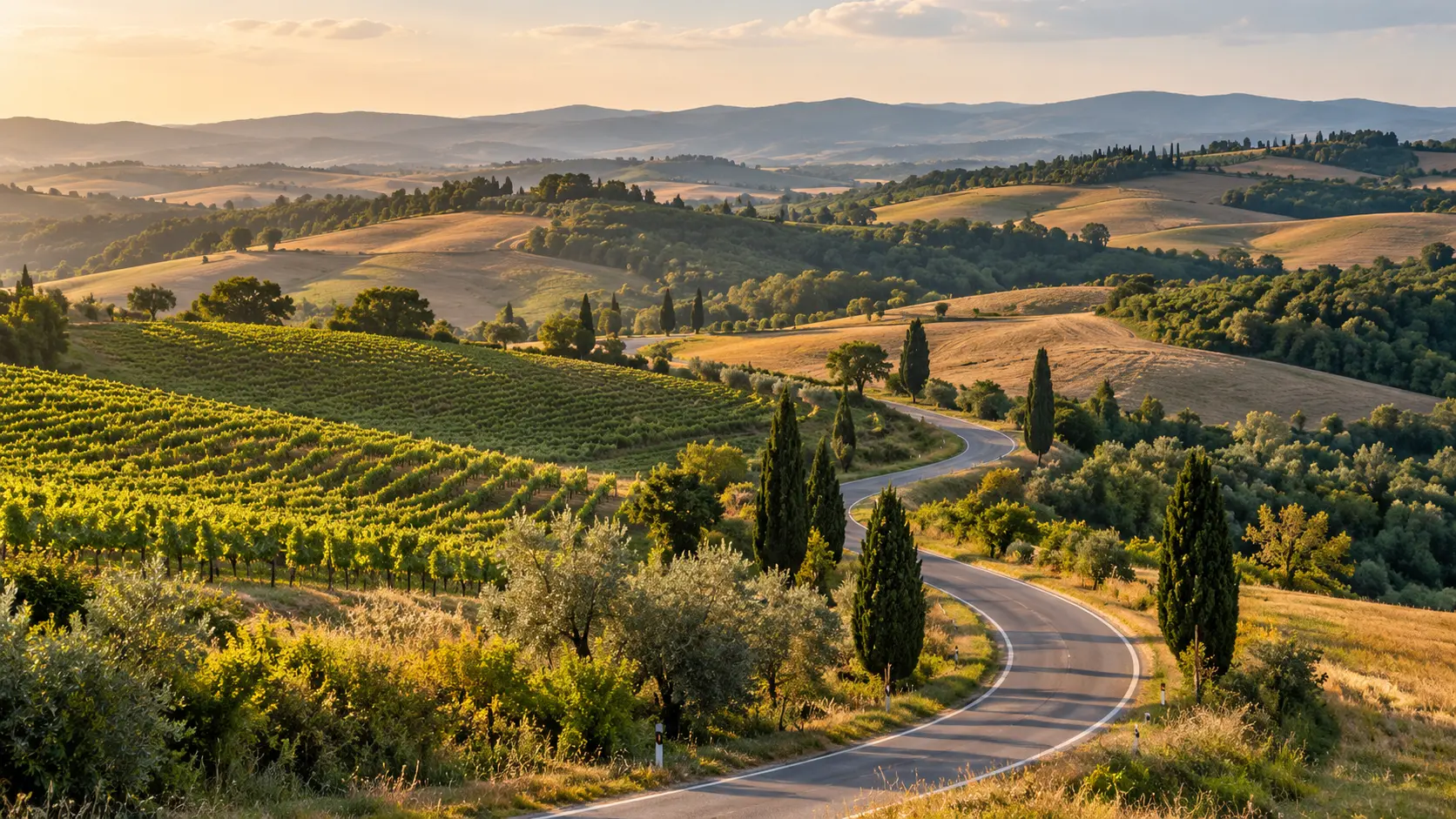
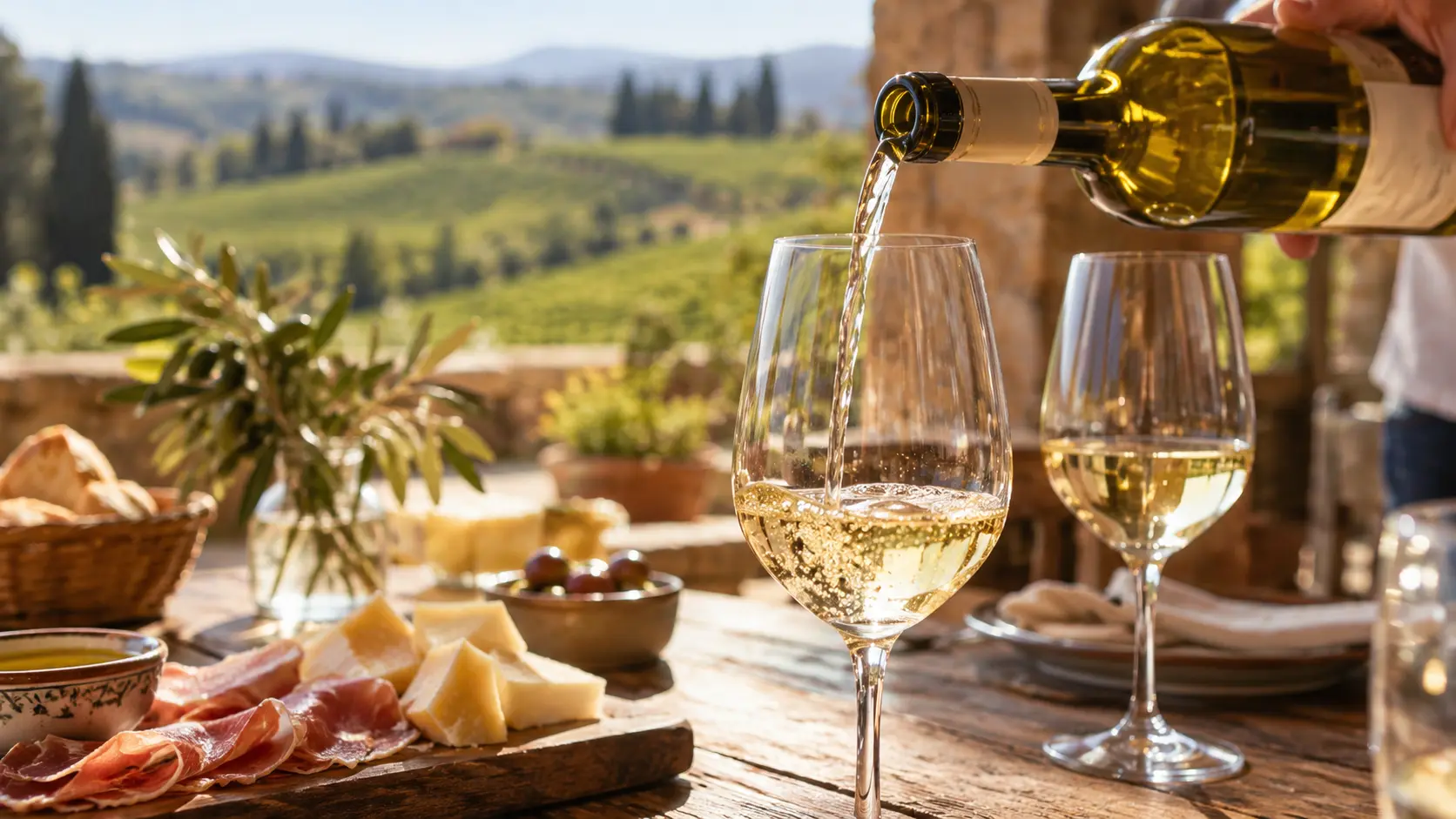
Between Siena and San Gimignano the tour stops at a family-owned estate in the Chianti hills. First comes an informal tasting of three of their wines: Chianti, Vernaccia and Vin Santo. Then you have lunch on the terrace. Expect homemade pasta, cured meats, local cheeses, salads and biscotti to dip in the Vin Santo.
The Vernaccia is the white you'll see again in San Gimignano's shop windows an hour later. It grows on the hills around the town. In 1966 it became the first Italian wine with DOC status.
San Gimignano, in short
Free time. Fourteen medieval towers still stand, out of around seventy at the town's peak. Most people end up in Piazza della Cisterna. Gelateria Dondoli there has won gelato world titles, and the queue shows it.
Pisa in the late afternoon
Pisa is the last stop, so you reach Piazza dei Miracoli towards the end of the afternoon. Your guide takes you around the Cathedral, the Baptistery and the Leaning Tower. Want to read up before the trip? Our guide to Piazza dei Miracoli explained covers the square in more detail.
The tower isn't the only building there that leans. The Baptistery also stands slightly off vertical, on the same soft, waterlogged ground. The tilt is small. Stand back on the lawn and line it up against the Cathedral, and you'll see it.
Pisa was a maritime republic. Work on the Cathedral began in 1064, and spoils from a raid on Palermo the year before paid for it. Siena, by comparison, made its money from banking and the inland trade routes.
If you want to climb the tower, we arrange a skip-the-line ticket. Climbs run in timed slots. On a day this full, the ticket time sets the rhythm of the whole afternoon, and the guide plans the drive from San Gimignano backwards from it. It's 251 steps, and children under eight can't go up.
Even if you stay on the ground, find the bronze doors on the side of the Cathedral facing the tower. This is the Porta di San Ranieri. Bonanno Pisano cast it around 1180, with scenes from the life of Christ in square panels. Look for the palm trees, a camel and the Magi on horseback. The doors sit a few metres from where the crowd stands for the classic photo.
Who this day suits
It's a long day, twelve hours from pickup to drop-off. You spend a good share of it in the van. The drive from San Gimignano down to Pisa crosses the Val d'Elsa and comes out towards the Arno valley. It's one of the prettier stretches. Outside summer, bring a light jacket. Siena in the morning can feel cool even when Pisa is warm by the afternoon.
Pisa and Siena in one day suits first-time visitors with only a few days in Florence. It also suits couples and families who want the famous names without organising three separate trips. And it works for anyone who would rather not drive in Tuscany. Young travellers from eight upwards can join, which matches the minimum age for the tower.
It's less suited to people who want to sit in one place for an afternoon. If that sounds like you, give Siena a whole day on its own.
The private tour starts from €580. The price includes the van, the guide, the walking tour of Siena, the wine tasting and the farmhouse lunch. You can cancel for free up to 24 hours before departure.