In this post
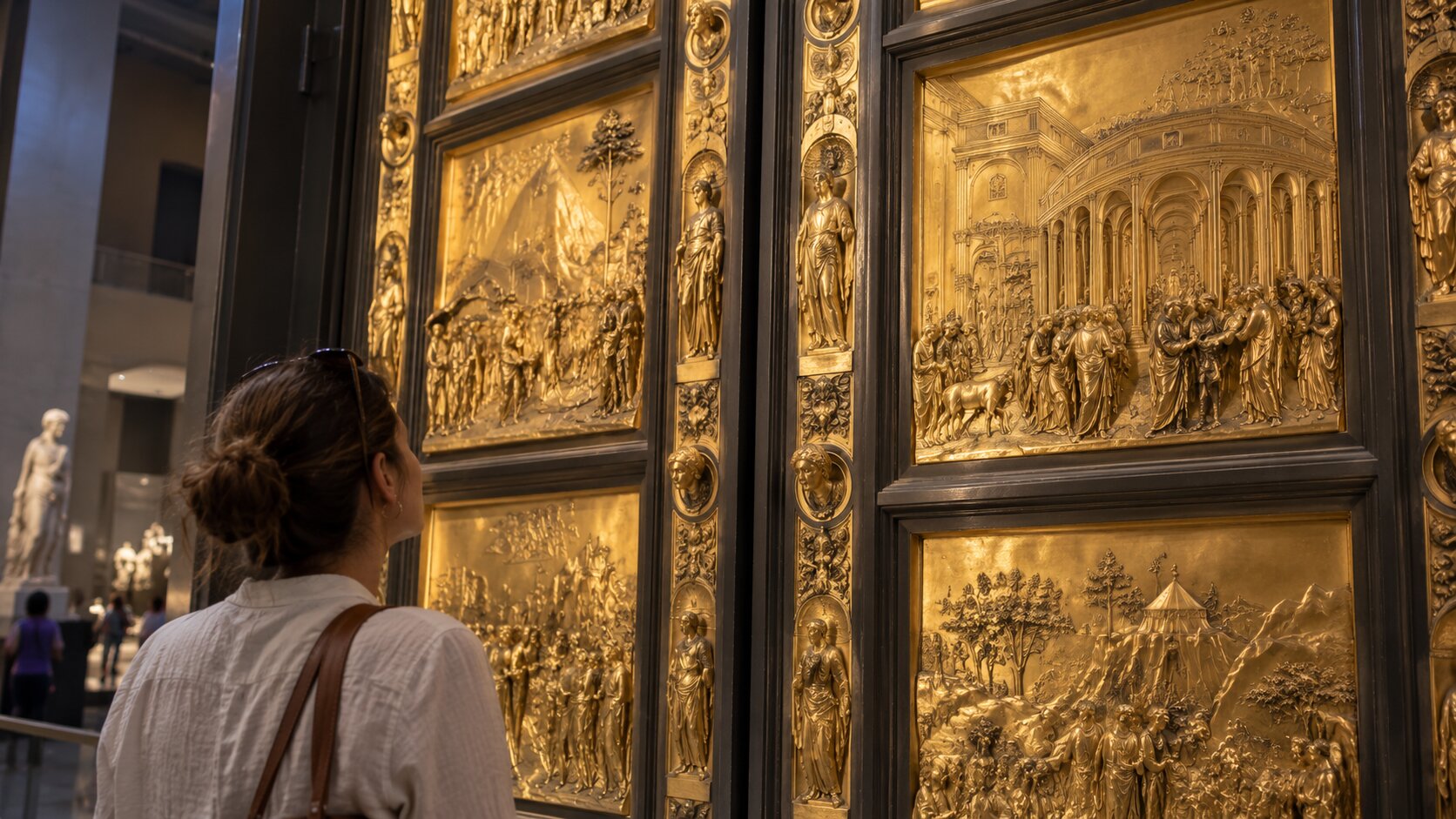
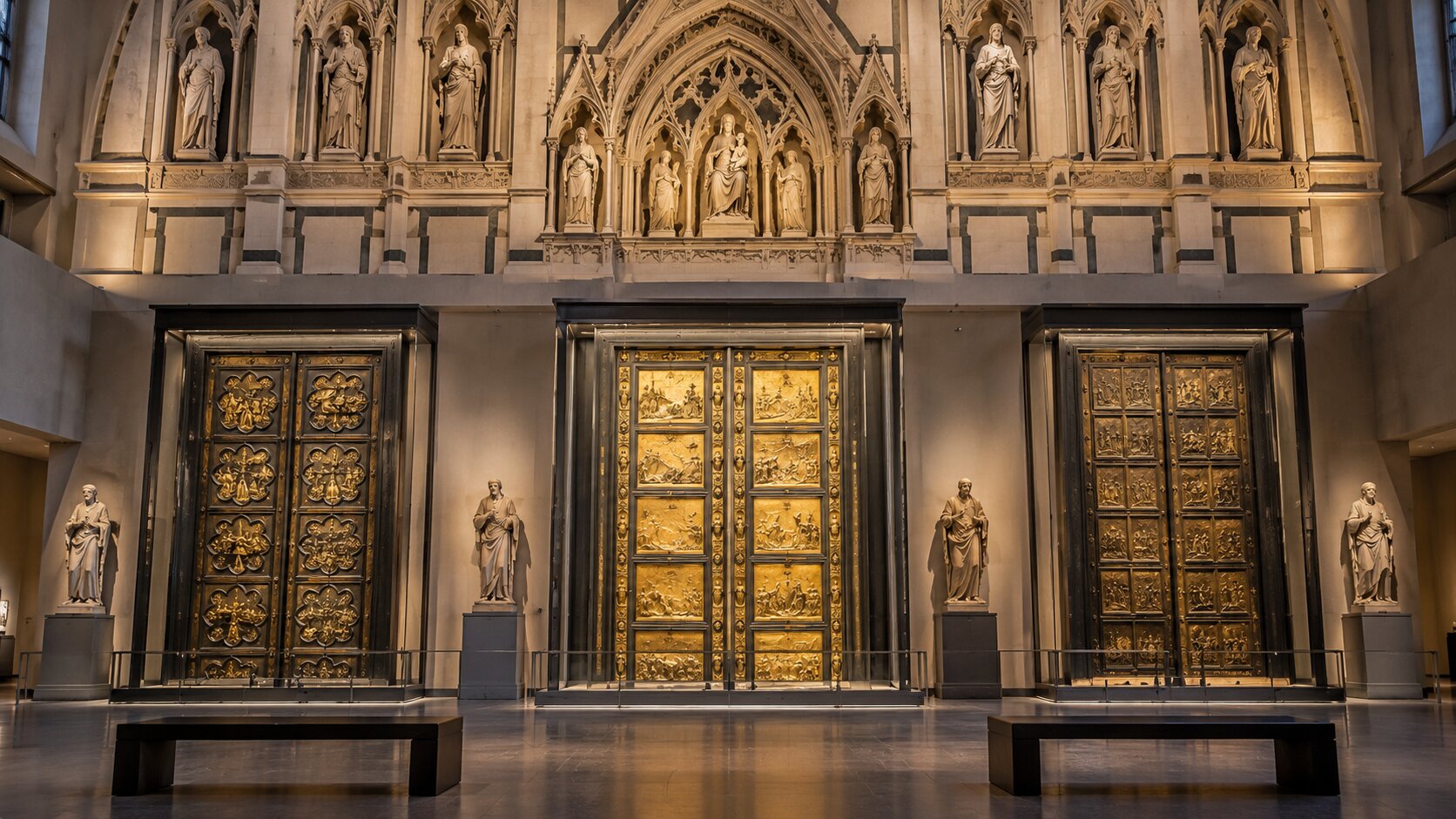
Every day, crowds in Piazza del Duomo photograph the east doors of the Baptistery. What they photograph is a bronze cast from 1990. Lorenzo Ghiberti's original Gates of Paradise in Florence stand in the Museo dell'Opera del Duomo, behind the cathedral apse. A glass case filled with nitrogen protects them. The doors measure just over five metres in height. In the museum you can stand close enough to see the chisel marks in the gilding.
Ghiberti worked on them from 1425 to 1452. The story starts a quarter of a century earlier, though, with another set of doors and a disputed competition.
The 1401 Competition
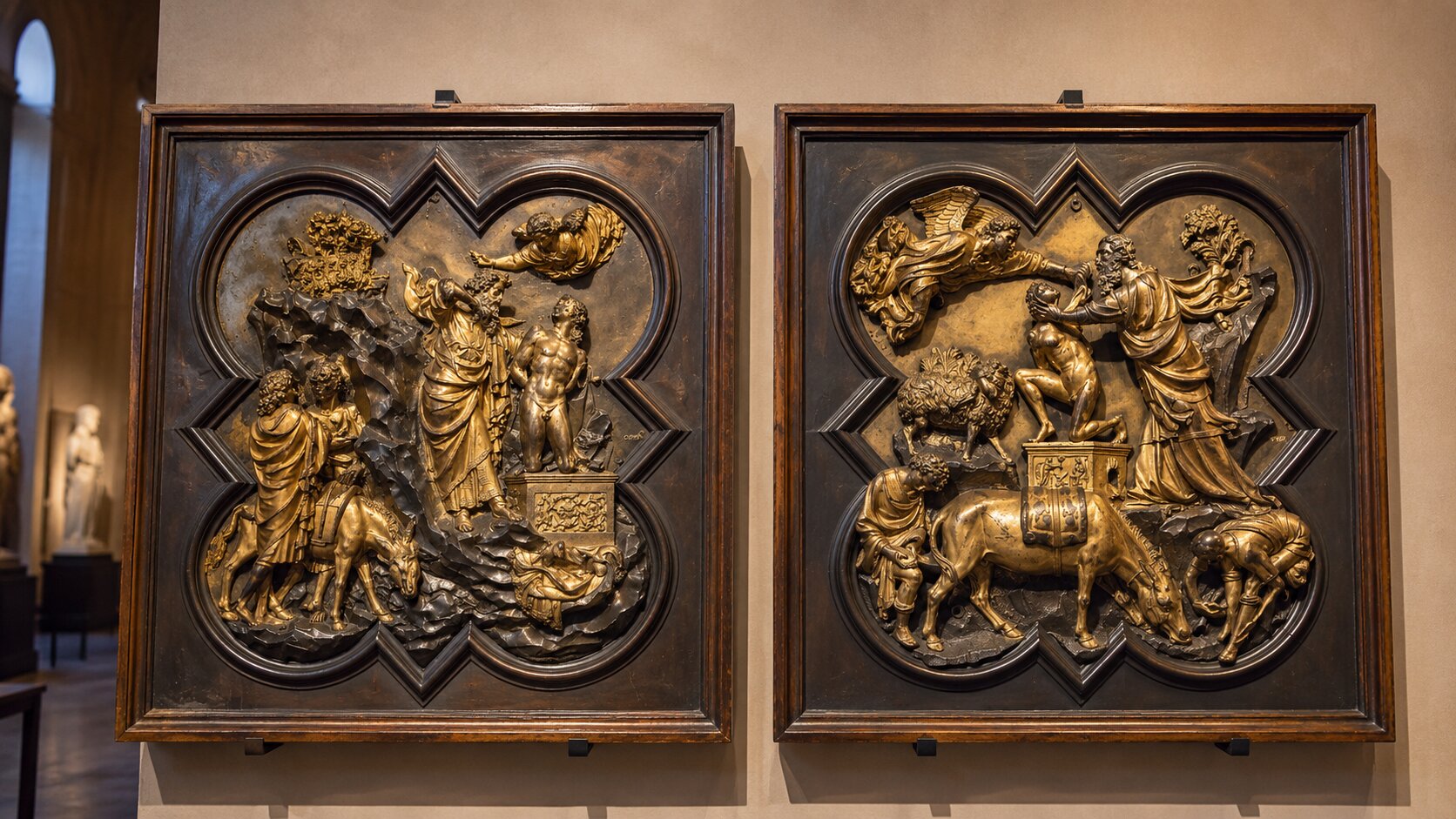
In 1401 the Arte di Calimala, the cloth merchants' guild, looked after the Baptistery. That year it launched a competition for new bronze doors on the north side. Each finalist cast a trial relief of the Sacrifice of Isaac. Two of these panels survive, one by Ghiberti and one by Filippo Brunelleschi. Both now hang in the Bargello.
Side by side, they reveal two different approaches. Ghiberti cast most of his relief in a single piece and used less bronze. That mattered to a guild paying for the metal. Brunelleschi assembled his panel from several separate castings.
Ghiberti won the commission at about 23. How clear his win was depends on who tells the story. In his Commentarii, written decades later, Ghiberti claims an outright victory. Brunelleschi's biographer, Antonio Manetti, says the jury split the prize. In his version, Brunelleschi pulled out instead of sharing the job with his rival.
Brunelleschi then went to Rome to study ancient architecture. That path eventually led him back to Florence and to the dome of Santa Maria del Fiore. He also worked for the Medici at San Lorenzo, where he built the Old Sacristy for Giovanni di Bicci de' Medici. Our guide to Medici sites in Florence covers that church.
The north doors kept Ghiberti busy from 1403 to 1424. He followed the layout of Andrea Pisano's older south doors, with 28 New Testament scenes in Gothic quatrefoil frames.
Ten Panels for the East Doors
In 1425, a year after the north doors went up, the guild gave Ghiberti the east doors too. This pair faces the cathedral. Ghiberti dropped the 28-panel scheme and made ten large square reliefs, each about 80 centimetres across. The Old Testament stories run from Adam and Eve at the top left to Solomon and the Queen of Sheba at the bottom right. Many panels combine several episodes, so the doors hold more than fifty scenes in all.
The way the space recedes sets them apart from earlier bronze reliefs. Ghiberti modelled foreground figures almost in the round. Behind them, buildings and landscapes flatten into very shallow relief. He organised the scenes with linear perspective, still a recent idea in Florence at the time. In the Jacob and Esau panel, an arcaded hall pulls the eye toward a single vanishing point. The story unfolds across the floor in separate groups of figures.
Ghiberti had trained as a goldsmith, and the finish shows it. He cast the reliefs with the lost-wax method, at a time when bronze cost more than marble. He then spent years chasing and fire-gilding the surfaces. Among the small heads in the frame you can find his self-portrait, a bald man looking out at the viewer. Next to him is his son Vittorio, who later took over the family workshop. Ghiberti himself called the doors the most singular work he ever made.
Who Named Them the Gates of Paradise?
Most accounts credit Michelangelo. Giorgio Vasari tells the story in his Lives of the Artists. According to Vasari, Michelangelo said the east doors were beautiful enough to stand at the gates of Paradise. The name has stayed with them ever since. Michelangelo's own late Pietà, the Bandini Pietà he carved for his tomb, now stands in the same museum. Our article on Michelangelo in Florence shows where to find the rest of his work in the city.
Some historians point to an older origin. Florentines called the open ground between the Baptistery and the cathedral the Paradiso. The east doors face exactly that space, so they may simply have taken its name.
Gates of Paradise Florence: Original or Copy?
The Gates of Paradise in Florence spent more than five hundred years outdoors. During the Second World War, the city took them down in 1943 and hid them in a railway tunnel near Incisa Val d'Arno. They went back on the Baptistery in 1948. On 4 November 1966, the Arno flood forced six of the ten panels off the doors. Restorers reattached them, but salts kept crystallising under the gilding and raising small blisters across the gold.
In 1990 the doors came down for good, and a bronze cast made from moulds of the originals took their place. Florence's state conservation laboratory, the Opificio delle Pietre Dure, carried out the restoration. Conservators cleaned the panels in baths of Rochelle salts and water. The frame was too risky to dismantle, so they cleaned it with a laser adapted for the job. The project ended in September 2012, more than 25 years after it began. That is almost as long as Ghiberti needed to make the doors. Salts can still form indoors, so a nitrogen-filled glass case now protects the originals.
The museum reopened in 2015 after a major expansion. Today the doors stand in its largest room, the Sala del Paradiso. One wall holds a full-scale reconstruction of the cathedral's medieval facade, which the city demolished in 1587. The reconstruction includes the statues that once decorated it. Opposite stand the three original Baptistery doors: Ghiberti's two sets and Andrea Pisano's. Their layout echoes the old piazza, with the doors facing the cathedral front.
Visiting the Doors with Walkabout
Our small-group Florence Duomo with Dome Climb Tickets and Museum Tour covers both versions of the doors. It meets in front of the Lindt shop at Piazza del Duomo 15R. The guide starts outside with the Baptistery, Giotto's bell tower and the Loggia del Bigallo. You then spend about an hour in the Museo dell'Opera del Duomo. Besides the Gates of Paradise, you see Michelangelo's Pietà and sculpture by Donatello. The second part of the tour climbs Brunelleschi's dome, 463 steps between its two shells. On the way up you get a close view of the frescoes inside the cupola.
Groups have a maximum of 15 people, and everyone gets a headset. The ticket includes a 72-hour pass to the cathedral complex. You can use it to visit the Baptistery interior or the bell tower on another day. The route involves a lot of stairs, so the tour does not suit wheelchair users or people with mobility problems.