In this post
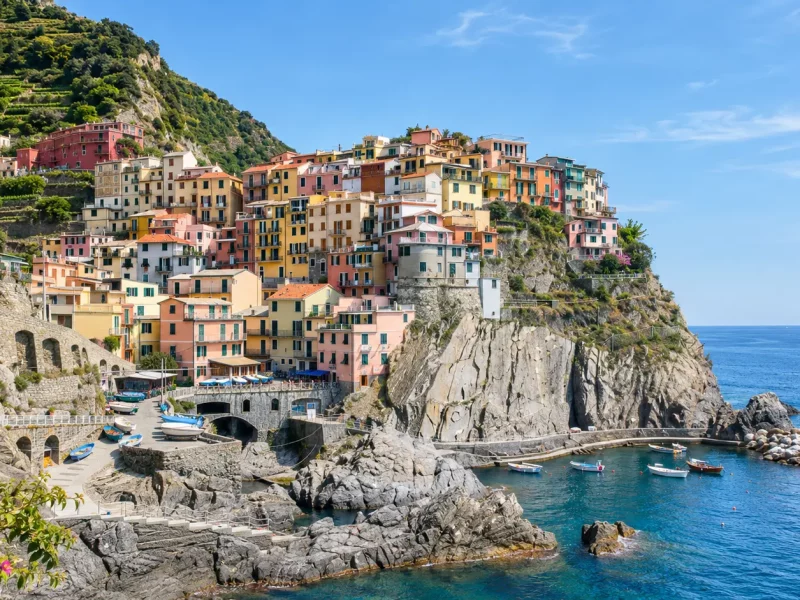
If you're staying in Florence and can give the coast one day, go to the Cinque Terre. Manarola is about two hours away by road, and you're back in Florence for dinner. The Amalfi Coast is the better choice only if you can spend two or three nights there. From Florence it takes around six hours door to door.
Both coastlines are steep and terraced, with houses in the same faded colours, and in photos they can look interchangeable. For anyone based in Tuscany, the comparison of Cinque Terre vs Amalfi Coast starts with a map. One is in Liguria, a short drive from Florence. The other is south of Naples.
How far each coast really is from Florence
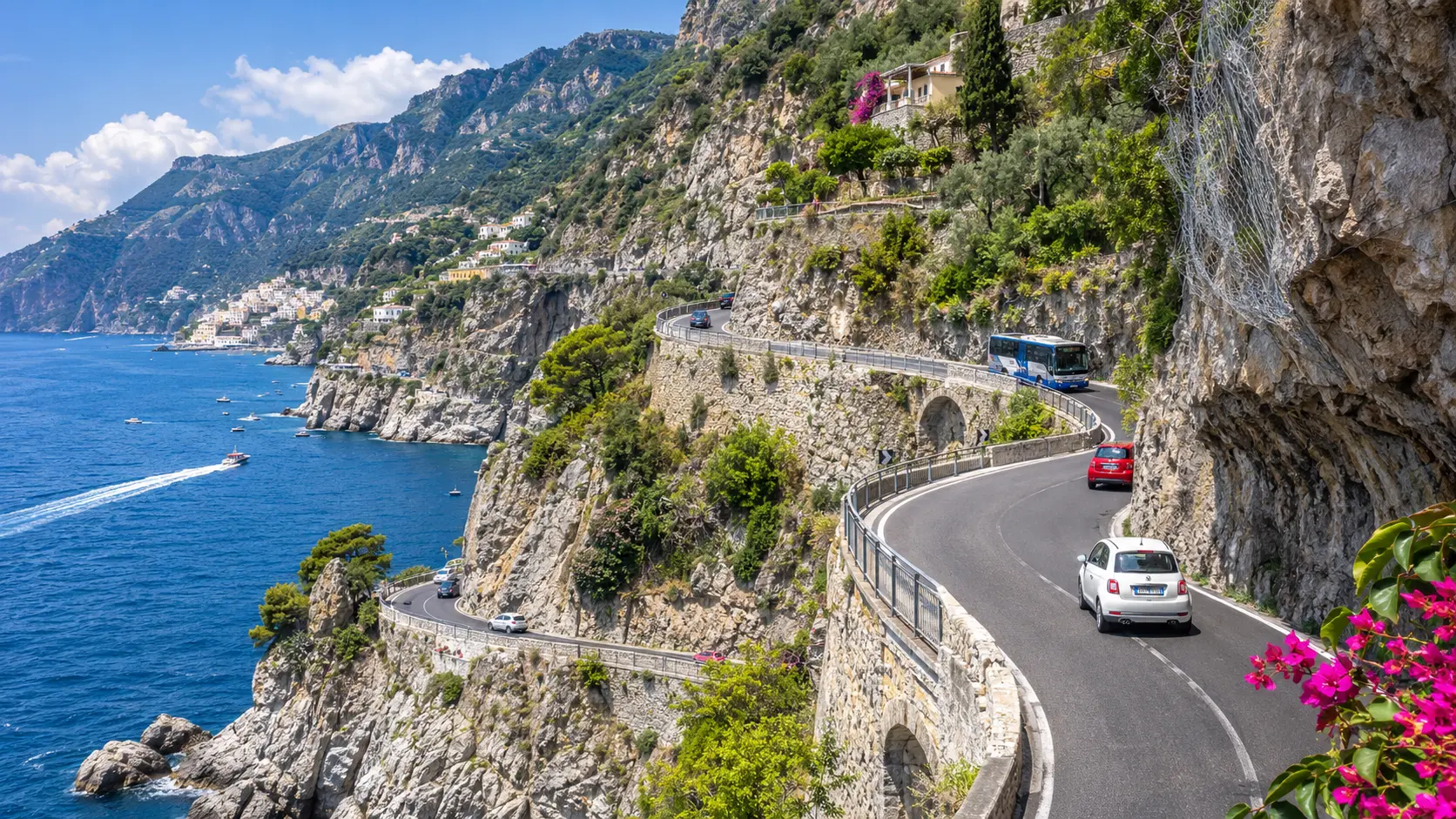
No railway line reaches Positano or Amalfi. From Florence you take a high-speed train to Naples or Salerno, which takes about three hours. Then you finish by ferry or by bus along the SS163, the coast road. It runs for roughly 50 km between Vietri sul Mare and Positano. It is about seven metres wide for both directions, buses included.
In summer it gets so busy that cars may use it only on alternate days, depending on whether the number plate ends in an odd or even digit. In 2026 the rule applied every day in August and September, from 10am to 6pm. It also covered weekends in June, July and October. Residents of the coast's 13 towns are exempt. Ferries are the nicer way in, but they run to a seasonal timetable and depend on the sea.
Leave Florence after breakfast and you'll reach Amalfi some time in the afternoon. That's an arrival day, not a day trip.
The Cinque Terre is on the Ligurian coast, north-west of Florence. The five villages are linked by one railway line, by footpaths and, from late March to October, by boat. Our private Cinque Terre tour from Florence picks you up at your hotel at 8am. National park admission and an all-day train ticket are included. The morning starts with a walk through the vineyards above Manarola, and nobody has to queue at the station ticket office.
Five villages, thirteen towns
The Amalfi Coast's 13 municipalities run along the Gulf of Salerno, and some of them are proper towns. Amalfi was the capital of a medieval maritime republic. It still has the cathedral to show for it, at the top of a long flight of steps off the main square. Ravello sits about 350 metres above the sea, with the gardens of Villa Rufolo and Villa Cimbrone. Positano is the one on the posters: houses stacked down a ravine to a dark pebble beach.
In the Cinque Terre, Monterosso is the largest village. Corniglia has no harbour at all and sits on a ridge, 380 steps above its station. The coast path from one end to the other is about 12 km. Each village has its own shape, from Vernazza wrapped round its little harbour to Manarola climbing straight up the rock. We look at the differences one by one in Cinque Terre villages explained.
In one day you can see four of the five villages, eat in one and swim in another. You come away feeling you've seen the whole coast. One day on the Amalfi Coast gets you Positano and Amalfi, and much of it goes on traffic.
Is either coast good for a beach holiday?
Neither is a sandy-beach destination. Positano's main beach is dark pebbles, mostly covered by rented sunbeds in summer. Many of the better coves on the Amalfi side are easiest to reach by boat. In the Cinque Terre, Monterosso has the only long stretch of beach. Elsewhere people swim off the rocks or from the harbour slipways, Vernazza's especially.
Several days on a sunbed, with a beach club and someone bringing drinks? The Amalfi Coast does that better. For a swim between villages the Cinque Terre is enough. On our day trip there's free time for it in Vernazza and again on the beach at Monterosso.
Walking between the villages
The famous walk on the Amalfi Coast is the Path of the Gods, from Bomerano in Agerola to Nocelle above Positano. It's around six or seven kilometres, high above the sea. After that come well over a thousand steps down into Positano, unless you take the little bus. Superb, but it's a day out in itself, with buses at both ends.
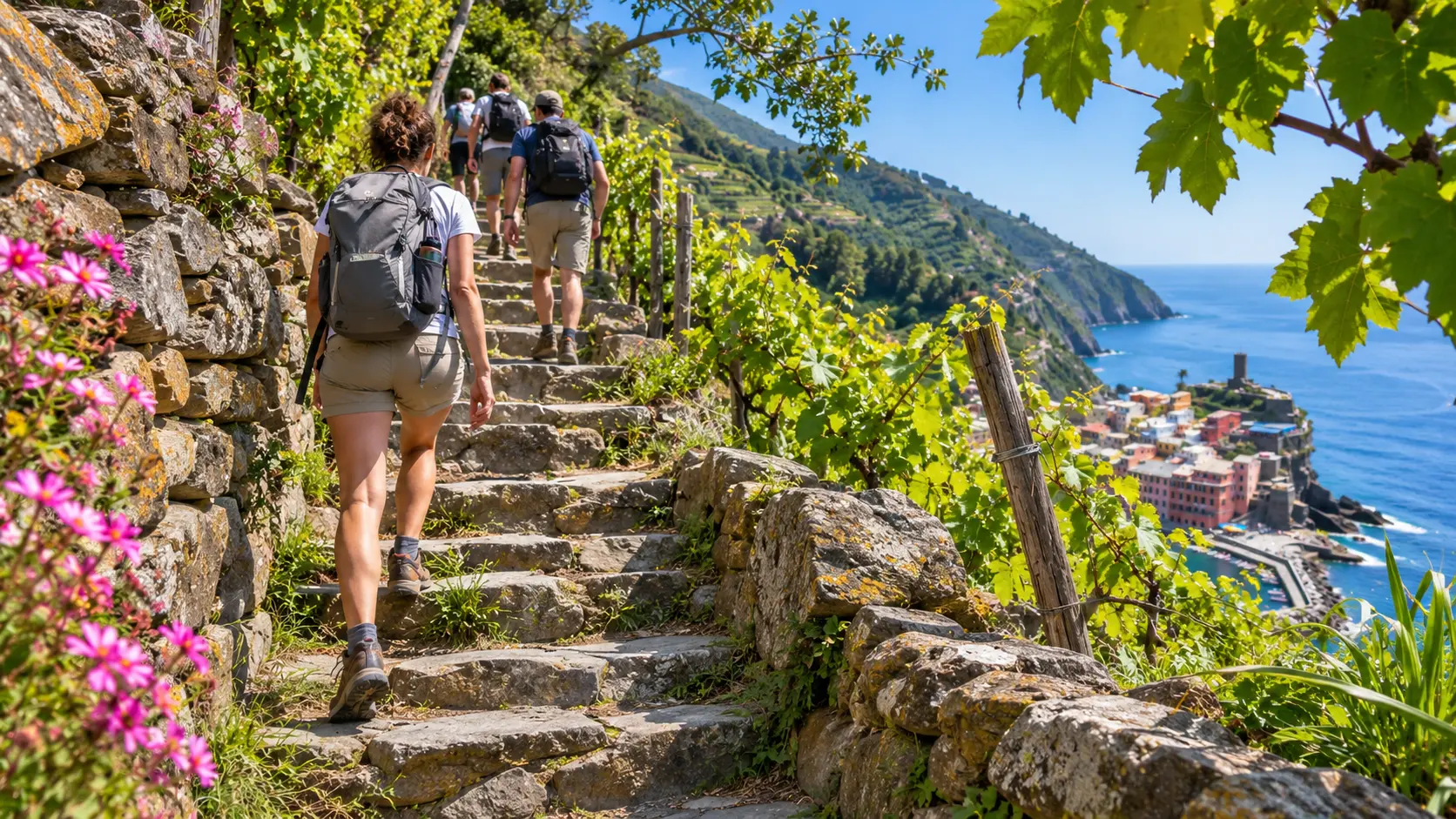
In the Cinque Terre, the paths connect the villages directly. Walking is simply one of the ways to get from one place to the next, so it fits into the middle of a day. On the private tour, the optional hike covers about four miles of old mule trails from Corniglia to Vernazza, after lunch. Some sections close after heavy rain or landslides. When that happens, the guide switches to another route or to the train. It's a real hike, with steps and uneven ground. Anyone who'd rather skip it rides the train and meets the walkers in Vernazza.
Hotels, crowds and seasons
Positano and Ravello have some of the best-known hotels in Italy, with terraces cut into the cliff. Many close between November and March, though.
The Cinque Terre has very few hotels. Most accommodation is rooms and small apartments in village houses, often up several flights of stairs. That's hard work with a suitcase. Keeping your Florence hotel and coming for the day avoids the problem entirely.
Both coasts are packed in July and August. In the Cinque Terre the busiest hours are usually late morning to mid-afternoon. That's when day visitors and cruise passengers from La Spezia overlap. Spring and early autumn are calmer on both coasts. The boat between the Cinque Terre villages runs from late March to October, weather permitting. Our guide to the best time to visit Cinque Terre goes through it month by month.
Cinque Terre vs Amalfi Coast on a single Italy trip
Many first trips to Italy run Rome, Florence, Venice, or something close to it. On that route, Cinque Terre vs Amalfi Coast is less of a contest than it looks. The Cinque Terre works as a day out from Florence. The Amalfi Coast fits at the Rome end, since Naples is a little over an hour from Rome by high-speed train. It deserves at least two nights of its own.
If the plan is a few slow days by the sea, with a good hotel and long lunches, give the Amalfi Coast its own stop and don't try to squeeze it in from Tuscany.
On the private day trip the order is set around the trains and the boat. It opens in Manarola, on the path that climbs through the vineyards above the village, with the houses below you and the sea behind them. From there it's one stop by train to Corniglia and the 380 steps up, which is when lunch starts to feel earned. Lunch is two courses at a family-run restaurant in the village.
The afternoon is looser. Walkers take the mule trail to Vernazza, everyone else takes the train, and the group meets again in Vernazza with free time for a swim, a drink at the harbour or just a seat in the piazza. Monterosso comes next, with its shops, the beach and an optional tasting of local wine. If the sea is calm, the boat back along the coast to Riomaggiore is the best view of the day, because it shows the villages you walked through from the water. Then it's the train to La Spezia and the van back to your hotel in Florence, about twelve hours after pickup, with the same guide all day.