In this post
- Why Florence Is the Best Place to Understand Michelangelo
- The Bargello: Michelangelo Before the Legend
- The Medici Chapels: Sculpture Beyond Portraiture
- The Museum of the Opera del Duomo: Michelangelo's Final Reflection
- The Accademia Gallery: The Summit of Michelangelo's Vision
- Seeing Michelangelo as a Continuous Journey
- Michelangelo's Florence Today
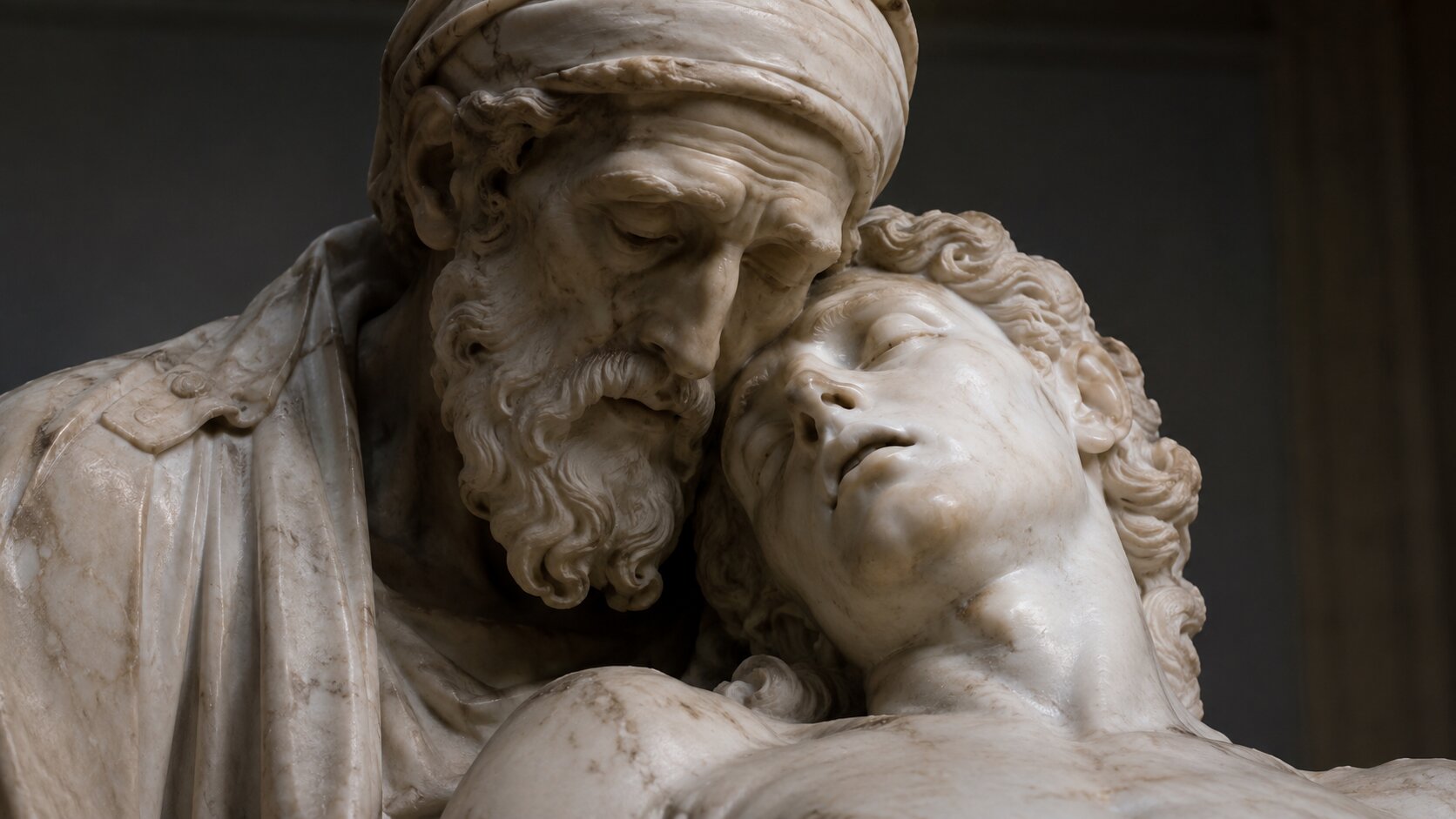
No sculptor shaped Florence's artistic identity more profoundly than Michelangelo.
Yet his legacy is rarely experienced as a single story.
Most visitors admire David, perhaps visit another museum, and leave with the impression of having seen Michelangelo's greatest achievement. In reality, the city preserves a far richer narrative. Across Florence, sculptures created over more than fifty years reveal an artist who continuously challenged himself, his material, and even his own understanding of beauty.
Following these works across the city means following the evolution of Michelangelo himself. From the bold confidence of his early years to the deeply emotional sculptures of old age, each masterpiece represents a different chapter in one of the most extraordinary artistic careers of the Renaissance.
Why Florence Is the Best Place to Understand Michelangelo
Michelangelo's career extended far beyond Florence. He worked extensively in Rome, designed architectural projects, painted the Sistine Chapel ceiling, and became one of the defining figures of the High Renaissance.
Yet Florence remains the city where his identity as a sculptor can be understood most clearly.
The sculptures preserved here span several decades and reveal an artist who never stopped refining his relationship with marble. They demonstrate how his interests changed over time, how his technical confidence grew, and how his understanding of the human body became increasingly expressive.
Perhaps more importantly, Florence allows visitors to experience these works in dialogue with one another. Instead of seeing isolated masterpieces, it becomes possible to recognise recurring ideas: tension, movement, anatomy, spirituality, and the constant search to free life from stone.
This continuity is what makes the city unique.
The Bargello: Michelangelo Before the Legend
For many travellers, the Bargello remains an unexpected discovery.
Overshadowed by the Accademia and the Uffizi, it receives fewer visitors despite housing one of Florence's most important collections of Renaissance sculpture.
For Michelangelo, the museum represents the beginning of the story.
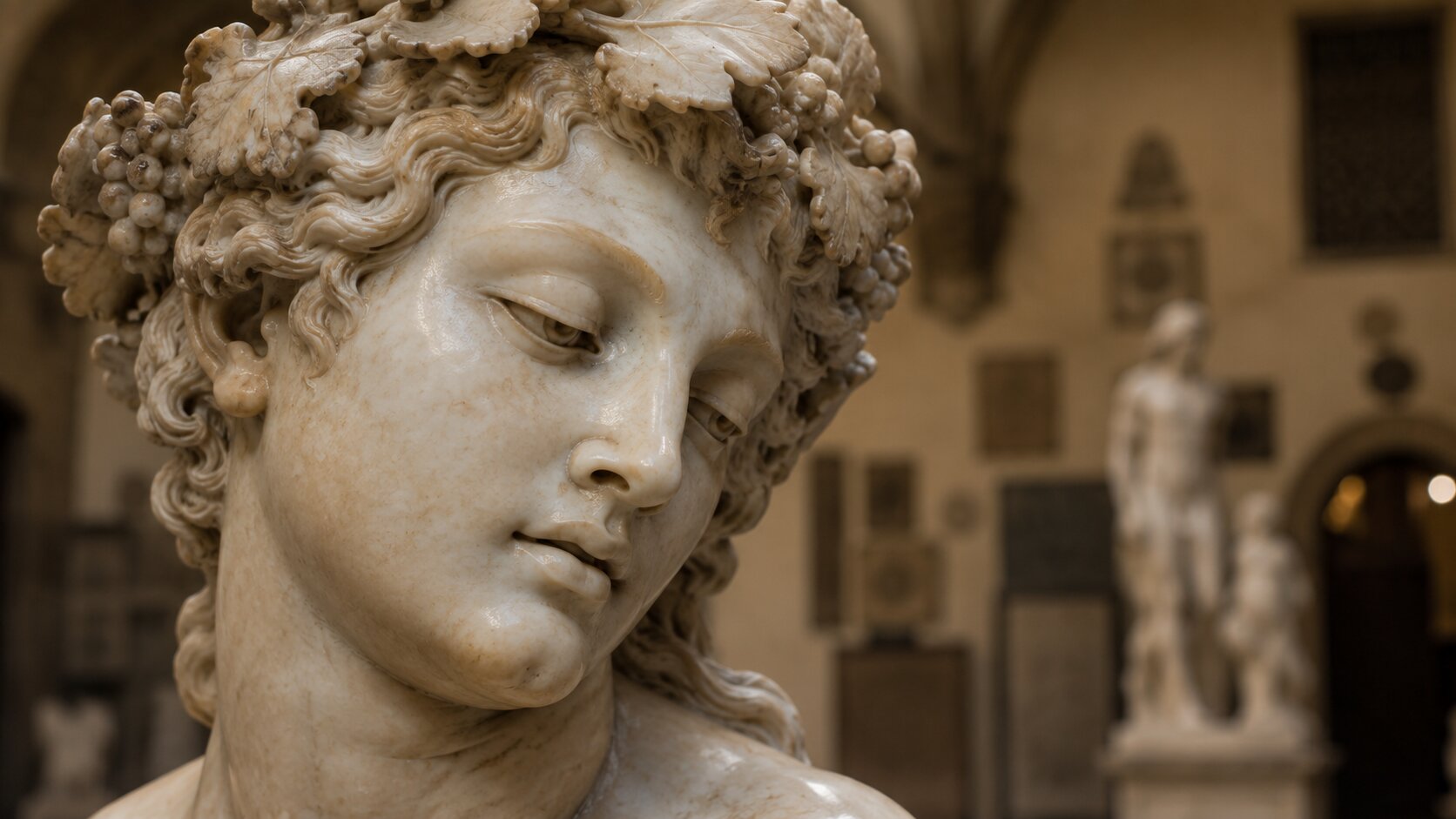
Here visitors encounter works such as Bacchus, Brutus, David-Apollo, and the Tondo Pitti, each revealing a different stage in the artist's development.
Bacchus, created while Michelangelo was still in his twenties, already demonstrates an extraordinary understanding of anatomy. Unlike the balanced harmony associated with classical sculpture, however, the figure appears unstable, almost swaying under the influence of wine. The subtle imbalance gives the marble an unexpected sense of movement and humanity.
Nearby, Brutus presents a completely different character. Rather than physical beauty alone, the sculpture explores psychological tension through expression and posture. Michelangelo was increasingly interested not simply in reproducing the human body, but in revealing emotion through stone.
The Bargello therefore introduces visitors to an artist still experimenting, testing possibilities, and gradually developing the sculptural language that would later define his greatest masterpieces.
The Medici Chapels: Sculpture Beyond Portraiture
The Medici Chapels reveal another transformation.
By the time Michelangelo designed the New Sacristy for the powerful Medici family, he had moved beyond creating individual statues. Sculpture had become part of a larger architectural vision.
The tombs of Giuliano and Lorenzo de' Medici are accompanied by the celebrated allegorical figures of Day, Night, Dawn, and Dusk. These sculptures are not portraits in the traditional sense. Instead, they reflect ideas about time, mortality, memory, and the passing of human life.
The figures appear simultaneously powerful and unfinished, calm yet restless. Their poses seem almost impossible, creating a dynamic tension that became one of Michelangelo's defining characteristics.
Understanding this commission also requires understanding the relationship between the artist and Florence's most influential family. The Medici did far more than finance individual works of art. They created an environment in which artists could develop ambitious ideas, experiment freely, and redefine Renaissance culture.
For readers interested in the broader influence of the family on Florence's artistic and political identity, our guide to Medici Sites in Florence explores how their patronage shaped the city that visitors experience today.
Within the chapels, sculpture is no longer simply decorative.
It becomes architecture, philosophy, and storytelling combined.
The Museum of the Opera del Duomo: Michelangelo's Final Reflection
If the Bargello represents youth and the Medici Chapels express artistic maturity, the Museum of the Opera del Duomo reveals Michelangelo at the end of his life.
The museum houses the Florentine Pietà, sometimes known as the Bandini Pietà, one of the artist's final and most personal sculptures.
Unlike the youthful confidence visible in David, this work carries a very different emotional weight.
Michelangelo intended the sculpture for his own tomb. Rather than celebrating physical perfection, it reflects meditation, suffering, faith, and mortality.
The figure of Nicodemus is widely believed to contain a self-portrait of the ageing artist. Whether this interpretation is accepted universally or not, the sculpture undeniably possesses an intimacy rarely found elsewhere in his work.
Even more revealing are the visible signs of incompletion.
Michelangelo attempted to destroy parts of the sculpture before abandoning it, frustrated by imperfections in the marble and perhaps by the emotional burden of the commission itself.
The result is remarkably moving.
Instead of polished certainty, visitors encounter vulnerability.
The marble no longer celebrates triumph.
It expresses humanity.
The Accademia Gallery: The Summit of Michelangelo's Vision
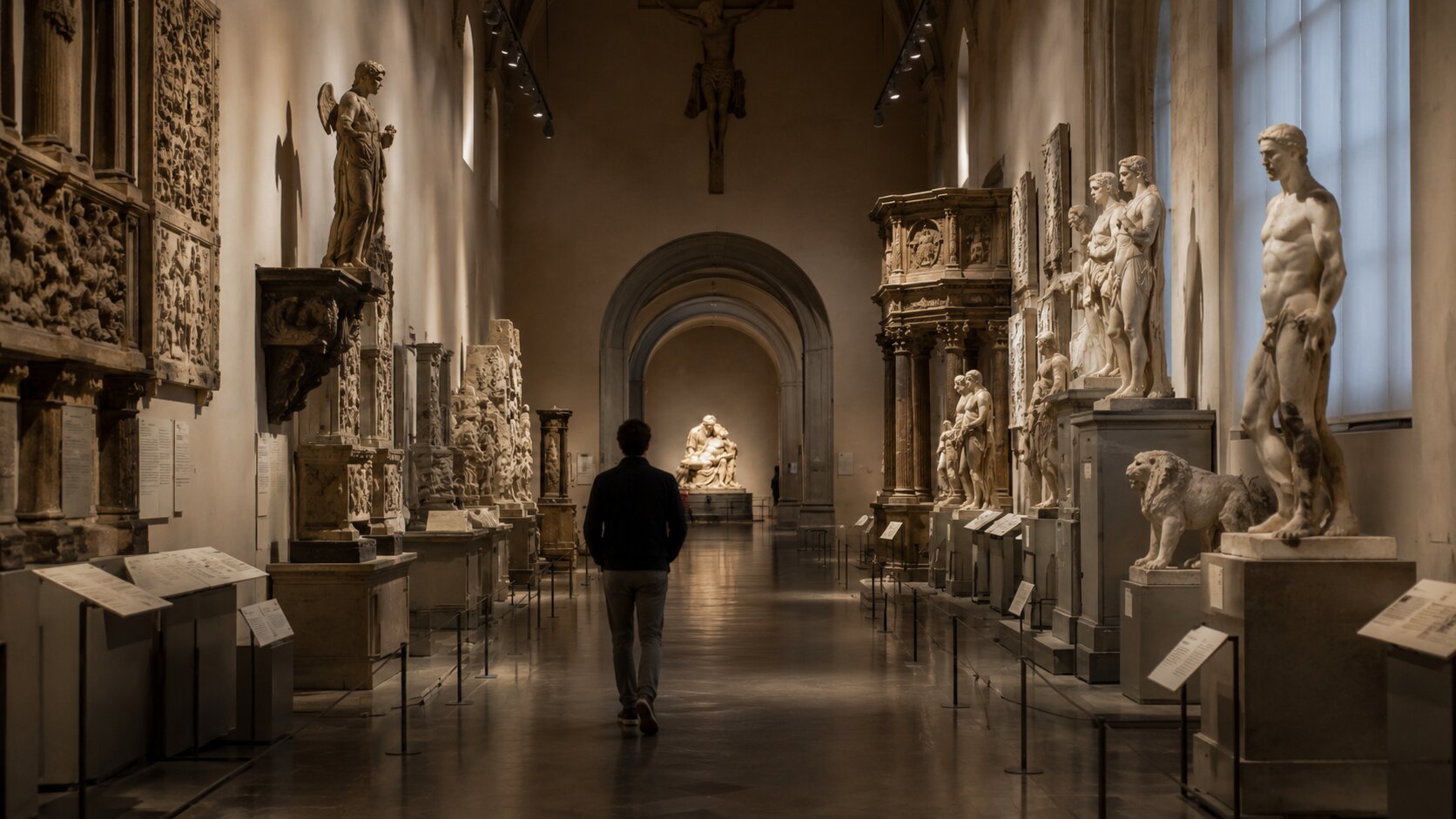
Every journey through Michelangelo's Florence naturally leads to the Accademia Gallery.
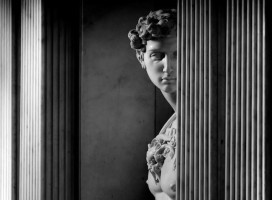
David remains one of the most recognisable sculptures ever created, yet understanding the works seen beforehand changes the encounter entirely.
Rather than appearing as an isolated miracle, David becomes the culmination of decades of artistic research.
The precision of the anatomy, the controlled tension before action, and the extraordinary confidence with which the figure occupies space all feel like the resolution of ideas first explored elsewhere.
The museum also contains the unfinished Prisoners, sculptures that seem to emerge directly from the marble itself.
These figures perfectly illustrate Michelangelo's belief that sculpture was not the act of creating form but of releasing it from within the stone.
The concept became one of his defining artistic philosophies.
For a deeper exploration of David, the Prisoners, and the lesser-known sections of the museum, our article Accademia Gallery Explained Beyond David examines how the gallery reveals far more than its most famous masterpiece.
Seen after the Bargello, the Medici Chapels, and the Opera del Duomo Museum, the Accademia becomes something more profound than a museum visit.
It becomes the final chapter of a much larger narrative.
Seeing Michelangelo as a Continuous Journey
One of the greatest misconceptions about Michelangelo is that his masterpieces exist independently from one another.
In reality, each sculpture helps explain the next.
The youthful experimentation of the Bargello leads naturally to the intellectual complexity of the Medici Chapels.
The spiritual introspection of the Florentine Pietà reveals an artist transformed by age and experience.
David, admired by millions each year, gains additional meaning when understood within this broader evolution rather than as a solitary achievement.
Following this sequence also changes the way Florence itself is experienced.
The city becomes more than a collection of museums connected by pleasant streets. It becomes an open narrative in which architecture, patronage, politics, religion, and artistic ambition intersect continuously.
Walking between these sites allows visitors to witness not only the development of Michelangelo's career but also the evolution of Renaissance Florence itself.
Michelangelo's Florence Today
More than five centuries after they were created, Michelangelo's sculptures continue to shape the identity of Florence.
Their influence extends beyond art history.
They define museum collections, inspire architectural spaces, and remain central to the city's cultural imagination.
Yet perhaps their greatest achievement is their ability to reward repeated observation.
Each sculpture reveals something different depending on where it is encountered within Michelangelo's career. Together they form a continuous conversation about beauty, movement, faith, power, and the possibilities of marble itself.
For visitors willing to move beyond a single masterpiece, Florence offers something rare: not simply the opportunity to admire Michelangelo's greatest works, but to understand how one of history's greatest sculptors thought, evolved, and transformed stone into enduring human expression.