In this post
- Why Getting Around Cinque Terre Isn't as Simple as It Looks
- The Train: The Main Way Between Villages
- Walking Between Villages: The Trail Alternative
- The Boat: A Seasonal, Weather-Dependent Option
- The Cinque Terre Card: What It Actually Covers
- How Weather Changes the Whole Day
- What Actually Complicates a Day of Getting Around Cinque Terre
- Planning a Realistic Day Around the Villages
- Getting Around Cinque Terre with Families or Limited Mobility
- Common Questions Before You Decide
- Why a Guided Day Trip Simplifies Getting Around Cinque Terre
- Five Villages, One Well-Managed Day
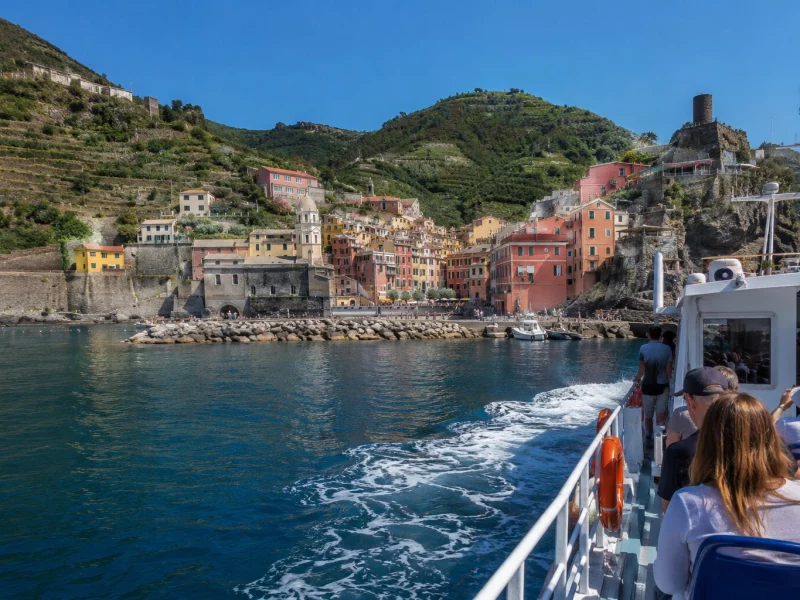
Five villages, one coastline, and almost no flat ground anywhere between them. Getting around Cinque Terre sounds simple on a map. In practice, it's the part of the trip most travelers underestimate. It's also the part that ends up shaping how the whole day actually feels.
The villages sit close together. Monterosso, Vernazza, Corniglia, Manarola, and Riomaggiore are strung along roughly 12 kilometers of cliffside coast. But close on a map doesn't mean easy to reach. There are no roads connecting most of them directly. That single fact changes everything about how a day here needs to be planned.
Why Getting Around Cinque Terre Isn't as Simple as It Looks
The terrain is the reason. Cinque Terre's five villages were built into cliffs that drop almost straight into the sea. For centuries, the only way between them was on foot, along paths carved out of necessity rather than convenience. Modern travelers have more options today, but the terrain hasn't changed. Every option for getting around Cinque Terre still has to work around it.
This is why so many visitors arrive with a rough plan and leave with a very different one. Trains get crowded. Trails close without warning. A boat that looked reliable online might not run at all that day. None of this is unusual here. It's simply part of what getting around Cinque Terre involves.
Understanding this before arriving changes the whole approach to planning. Instead of building a rigid schedule and hoping it holds, treat the day as something flexible. Small adjustments along the way are normal here. That single shift in mindset tends to matter more than any single tip about tickets or timetables.
The Train: The Main Way Between Villages
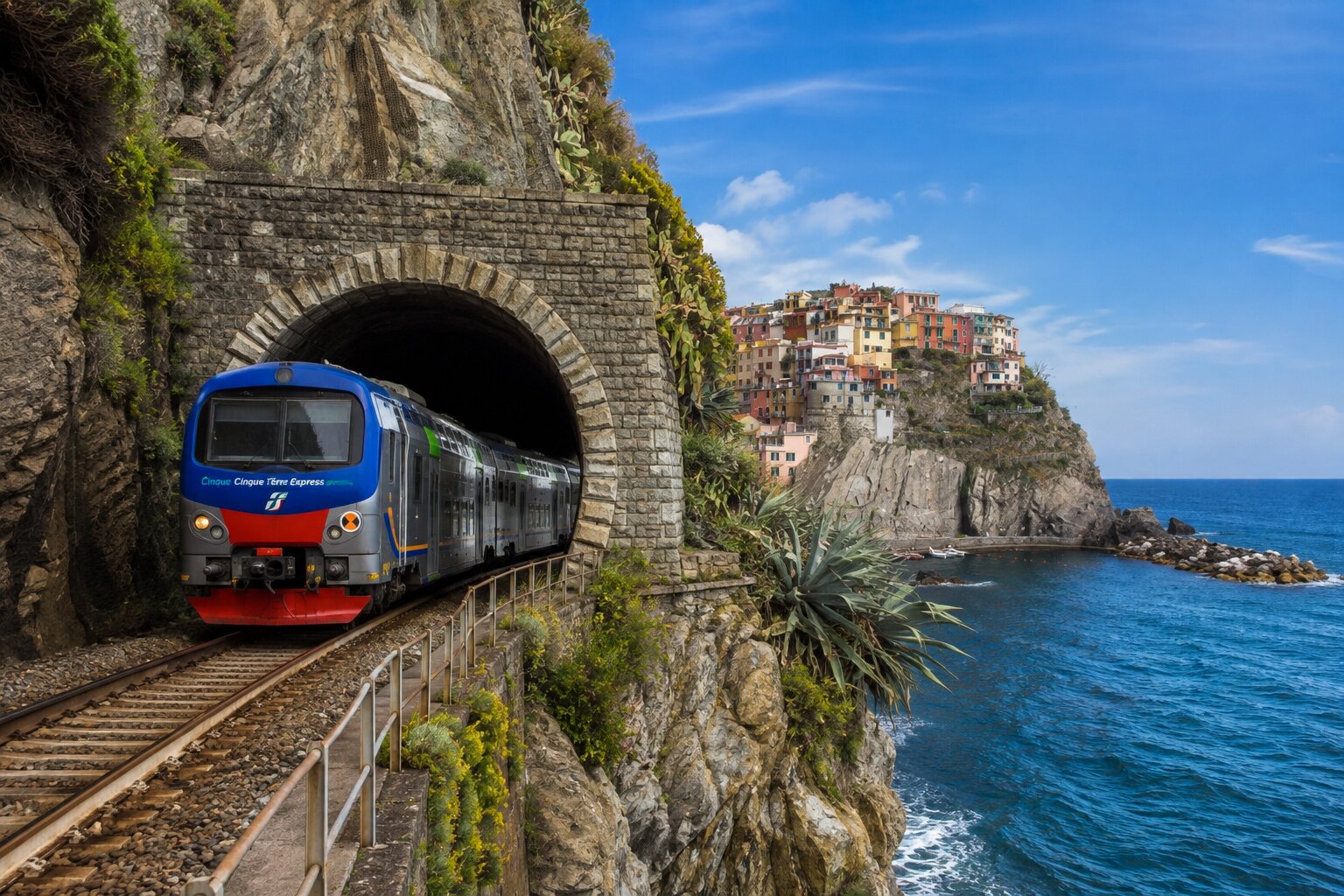
The regional train is the backbone of transport in Cinque Terre. It connects all five villages in minutes, running through tunnels cut directly into the cliffs. For most travelers, it's the default way to move along the coast.
The convenience comes with real trade-offs. In peak season, platforms fill up fast, and trains can be standing-room only for the short hops between villages. Ticket machines are often crowded too, and a missed connection can eat up more of the day than expected. The train solves the distance problem. It introduces a crowd problem in its place, especially between late morning and mid-afternoon.
Timing matters more than most travelers expect. The first trains of the morning tend to be the calmest. Day-trippers from Florence, Genoa, and La Spezia haven't arrived in numbers yet. By midday, that calm is gone. The early morning window is usually worth protecting, even if it means an earlier start than planned.
Walking Between Villages: The Trail Alternative
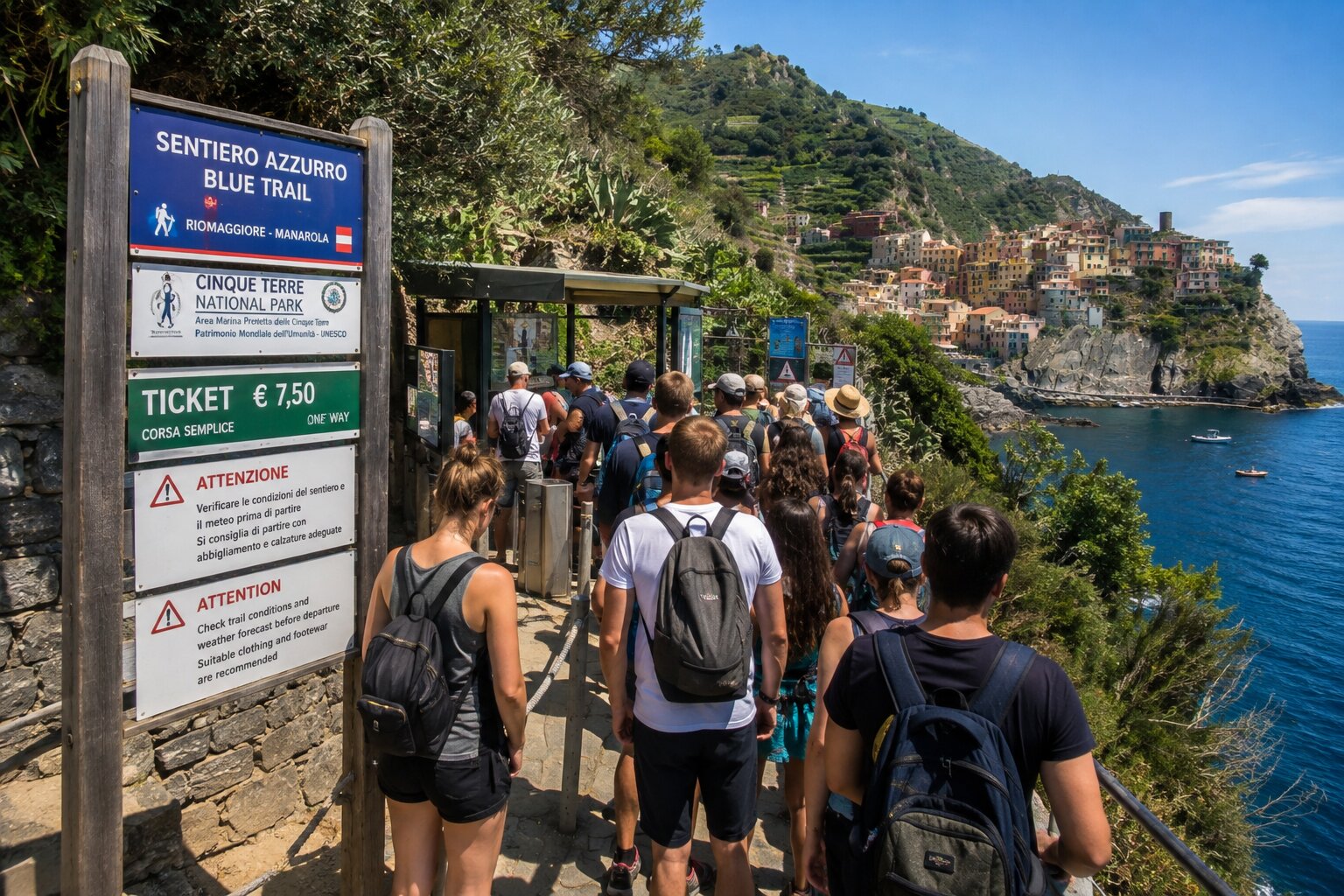
Some travelers want to skip the train, at least for part of the day. The historic trail network offers a different way through. The main coastal route, the Sentiero Azzurro, once connected all five villages on foot. Sections of it still do, though not always the same sections year to year.
Walking changes the pace entirely. Villages that look a few minutes apart by train can mean a real hike on foot. Steep climbs and uneven stone steps are the norm, not the exception. Our guide to Cinque Terre hiking trails goes deeper into what these paths actually involve. That includes why some of them, like the famous Via dell'Amore, have spent years closed for repair after landslides.
That last point matters more than it might seem. Trail conditions here shift with the weather and the season. A route that's open in spring might be closed after heavy autumn rain. Anyone planning a day around walking between two specific villages needs a backup plan. The trail itself isn't guaranteed to cooperate.
Distances also deceive on a map. Two villages that sit a few centimeters apart on paper can mean real effort in reality. Climbing and descending stone steps for an hour or more is common. Elevation, not straight-line distance, is what actually determines how long a walking section takes. That's easy to underestimate until you're standing at the bottom of the first set of steps.
The Boat: A Seasonal, Weather-Dependent Option
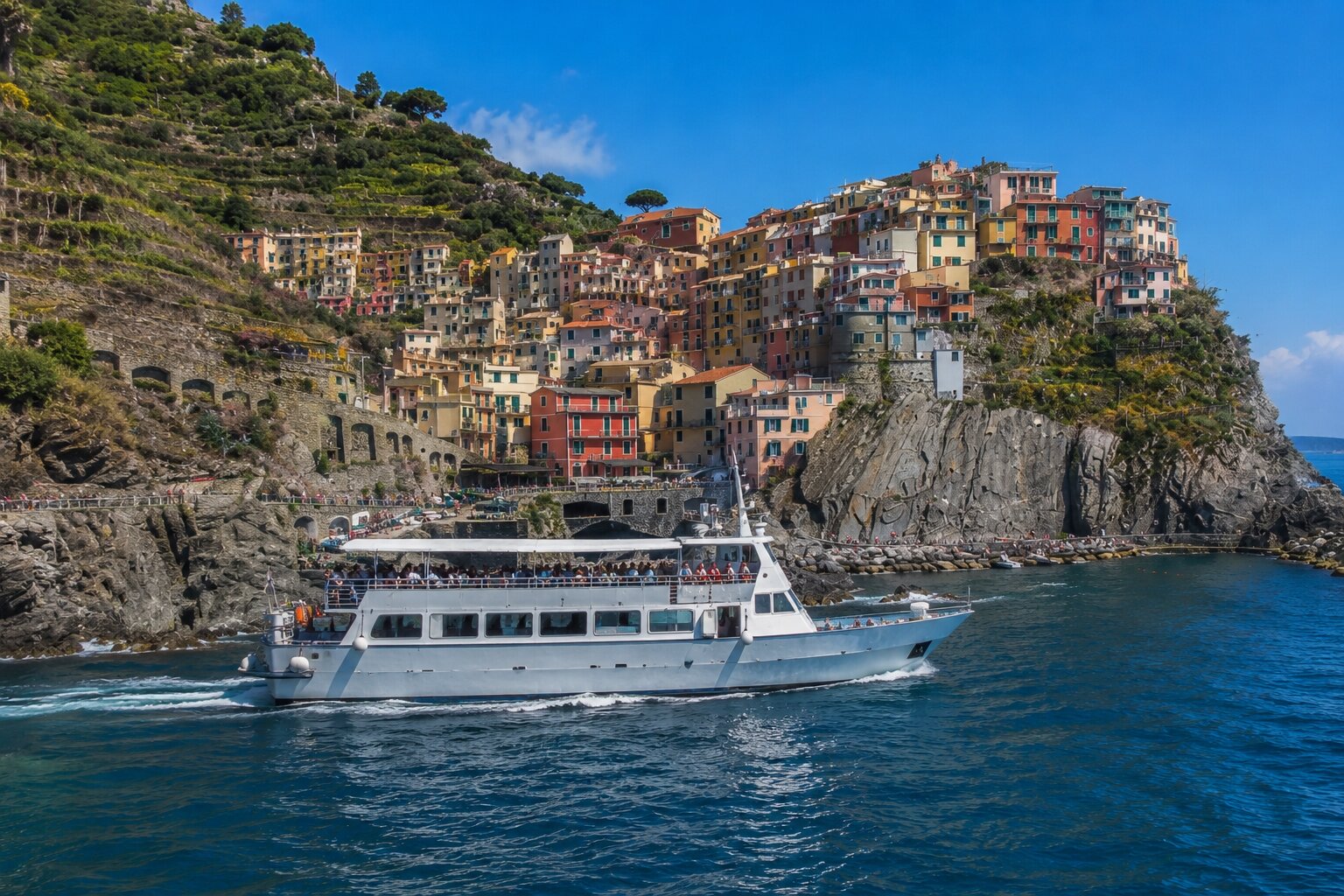
Between late March and late October, weather permitting, a boat service runs along the coast. It connects several of the villages by sea and offers a completely different perspective. The cliffs and villages look different from the water than from a train window or a cliffside path.
The catch is right there in the description: weather permitting. Rough seas cancel the boat with little notice, and outside that seasonal window it doesn't run at all. It's a wonderful way to see the coast when conditions allow, but it can't be the backbone of a plan. It has to be a bonus, not a guarantee.
Travelers who build an entire day around a specific boat departure sometimes face a scramble. The whole schedule can need reworking at short notice. Treating the boat as a possible highlight, rather than a fixed point on the itinerary, avoids that particular disappointment.
The Cinque Terre Card: What It Actually Covers
Most visitors moving between villages by train need a Cinque Terre Card. It bundles train travel with access to some of the hiking trails inside the National Park. It sounds straightforward, but the details trip people up. Card types vary. Validity periods vary. And the card has to be validated correctly before boarding. Travelers risk a fine otherwise, on a train that already feels crowded and confusing.
None of this is complicated in isolation. The difficulty is doing it all correctly, in a language that may not be your own. And doing it while also trying to enjoy five villages in a single day.
How Weather Changes the Whole Day
Weather plays a bigger role in getting around Cinque Terre than most first-time visitors expect. A sunny morning can turn into an afternoon downpour that closes a trail section within the hour. Rough seas can cancel the boat before it ever leaves the dock. Even the train, the most reliable option, can see delays during severe weather along the coast.
This unpredictability is part of why so many independent itineraries fall apart partway through the day. A plan built around perfect conditions rarely survives contact with an actual Ligurian afternoon. Building in flexibility from the start works better than locking in a fixed route weeks in advance. It tends to produce a smoother day regardless of what the weather does.
What Actually Complicates a Day of Getting Around Cinque Terre
Put together, the real challenge of getting around Cinque Terre isn't any single piece. It's the combination. A crowded train here, a closed trail section there. A boat that isn't running that day, a ticket validated incorrectly. Each issue is minor on its own. Stacked together across a single day, they can eat hours out of a trip. That trip only has so many hours to begin with.
Cinque Terre draws roughly 2.5 million visitors a year into a National Park with very little room to absorb them. Peak season makes every part of this harder. Trains run fuller. Trail entrances see longer queues. Villages that feel intimate in photos can feel overwhelming in person during July and August. None of this means the trip isn't worth it. It means the logistics deserve real thought before the day begins, not halfway through it.
Language adds another layer travelers rarely anticipate. Station announcements, ticket machine instructions, and trail signage are not always available in English. Staff at the ticket counter during peak hours have very little time to explain the system to every traveler who asks. Small misunderstandings compound quickly when five different transport decisions all need to go right in the same day.
Planning a Realistic Day Around the Villages
Travelers who do their own planning tend to fall into one of two traps. Some try to see all five villages and end up rushing through each one to catch the next train. Others underestimate how long the walking sections take and run out of daylight before finishing the route they planned.
A useful principle here is to think in terms of pace rather than checklist. Our guide to a Cinque Terre itinerary looks at how to structure a single day around the coast. It focuses on flow rather than forcing every village into a rigid schedule. Getting around Cinque Terre works best when the plan has some flexibility built in. Trains, trails, and boats all have a way of not quite matching what was planned the night before.
Getting Around Cinque Terre with Families or Limited Mobility
Steps and steep paths define much of Cinque Terre. That reality changes how families and travelers with limited mobility need to think about the day. Corniglia's 380 steps from the station to the village center are just one example. Several other villages involve similar climbs simply to reach the main square.
Strollers are difficult to manage on many of these paths. Elderly travelers, or anyone with mobility concerns, often find the walking sections more demanding than photos suggest. The train remains the most accessible way to move along the coast. Crowded platforms and standing-room train cars during peak hours still add their own challenge for anyone traveling with young children or heavy bags.
This is another area where a guided day trip tends to smooth out the rough edges. A guide already knows which villages involve the least walking. They also know which stretches of stairs can be avoided altogether, and can shape the day around what the group can comfortably manage. That kind of real-time adjustment is difficult to replicate from a guidebook or a forum thread written about someone else's trip.
Common Questions Before You Decide
A few questions come up again and again when travelers first start planning. How many villages can realistically fit into one day. Whether it's worth attempting a hiking section without prior experience on similar terrain. What happens if a train is missed or a trail closes partway through the day.
None of these questions has a single universal answer. It depends on the season, the weather that particular week, and how much walking each traveler genuinely wants to do. That variability is part of why so many visitors hand the logistics over to someone else. Someone who deals with these conditions every week, rather than trying to solve them all in advance from home.
Why a Guided Day Trip Simplifies Getting Around Cinque Terre
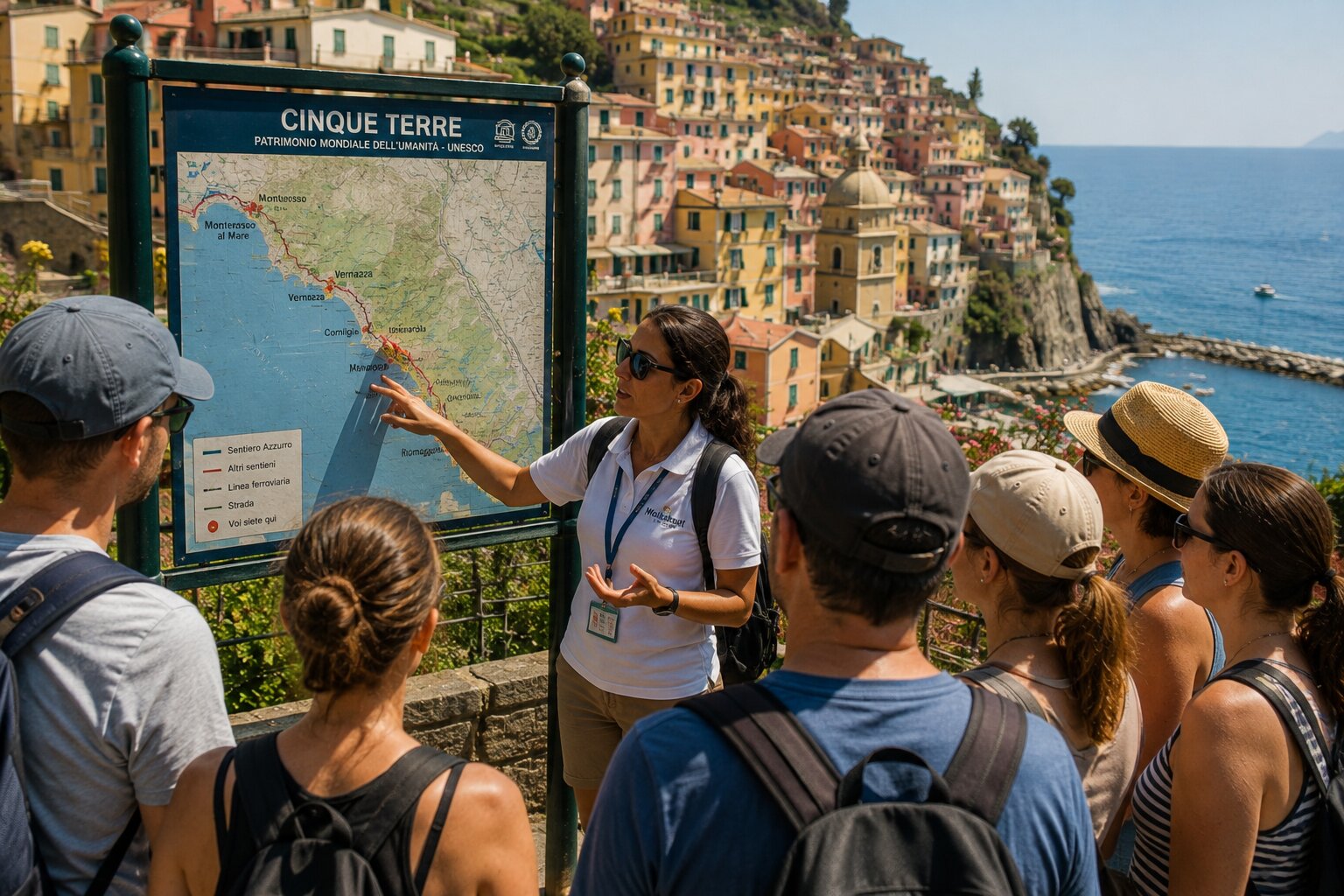
This is exactly the problem a guided day trip is built to solve. Managing train tickets, checking trail conditions, and hoping the boat runs that day usually falls to the traveler. On a guided trip, that whole question of getting around Cinque Terre is handled before the group even leaves Florence.
A guide manages the train connections between villages. There's no risk of missing a platform or validating a ticket incorrectly. The hiking sections, when conditions allow, get chosen and led by someone who already knows which parts of the trail are open that week. When the boat is running, it becomes part of the day rather than something to track separately online. Every piece that usually causes stress for independent travelers becomes someone else's responsibility for the day.
This matters most for a coastline where conditions genuinely change from one week to the next. What worked for another traveler's trip last month may not apply to yours. A guide adjusts to that in real time, something no amount of pre-trip research can fully replace.
There's also a practical time benefit that's easy to overlook. Every minute spent figuring out a ticket machine or checking a departure board is a minute not spent looking at the coastline. Backtracking after a wrong turn costs the same. Over the course of a full day, those minutes add up to something closer to hours. A pre-planned route simply doesn't lose that time.
Five Villages, One Well-Managed Day
Getting around Cinque Terre independently is entirely possible, and plenty of travelers do it successfully every year. But it takes research and flexibility. It also takes a willingness to adjust plans on the fly. A packed train or a closed trail can change the day fast.
Our Cinque Terre Day Trip from Florence removes that uncertainty from the equation. The coach ride out, the train connections between villages, and the choice between hiking a section of trail or continuing by rail all come built into a single, guided day. The seasonal boat ride along the Riviera is part of it too, when conditions allow. Travelers get the villages, the coastline, and the walking trails without having to solve the transport puzzle themselves. More of the day is left for the parts of Cinque Terre that actually drew them here in the first place.