In this post
Walk up Via San Giovanni and the shop windows start early. Ceramics, leather, linen, boar-shaped salami, tower-shaped fridge magnets. Some of it is made a few streets away. A lot of it isn't. San Gimignano local crafts are real and still very much alive, but they sit in a handful of specific workshops, and you have to know where to look before your free time runs out.
On our Best of Tuscany day trip, San Gimignano comes right after the winery lunch. The drive from the estate takes about ten minutes, so you arrive fed, a little sleepy and ready to wander. This guide is about spending that time on the things the town actually makes.
Clay first: the heart of San Gimignano local crafts
If one material defines the town's workshops, it's clay. You'll see painted plates everywhere, but the most interesting ceramic stop sits just behind the main square.
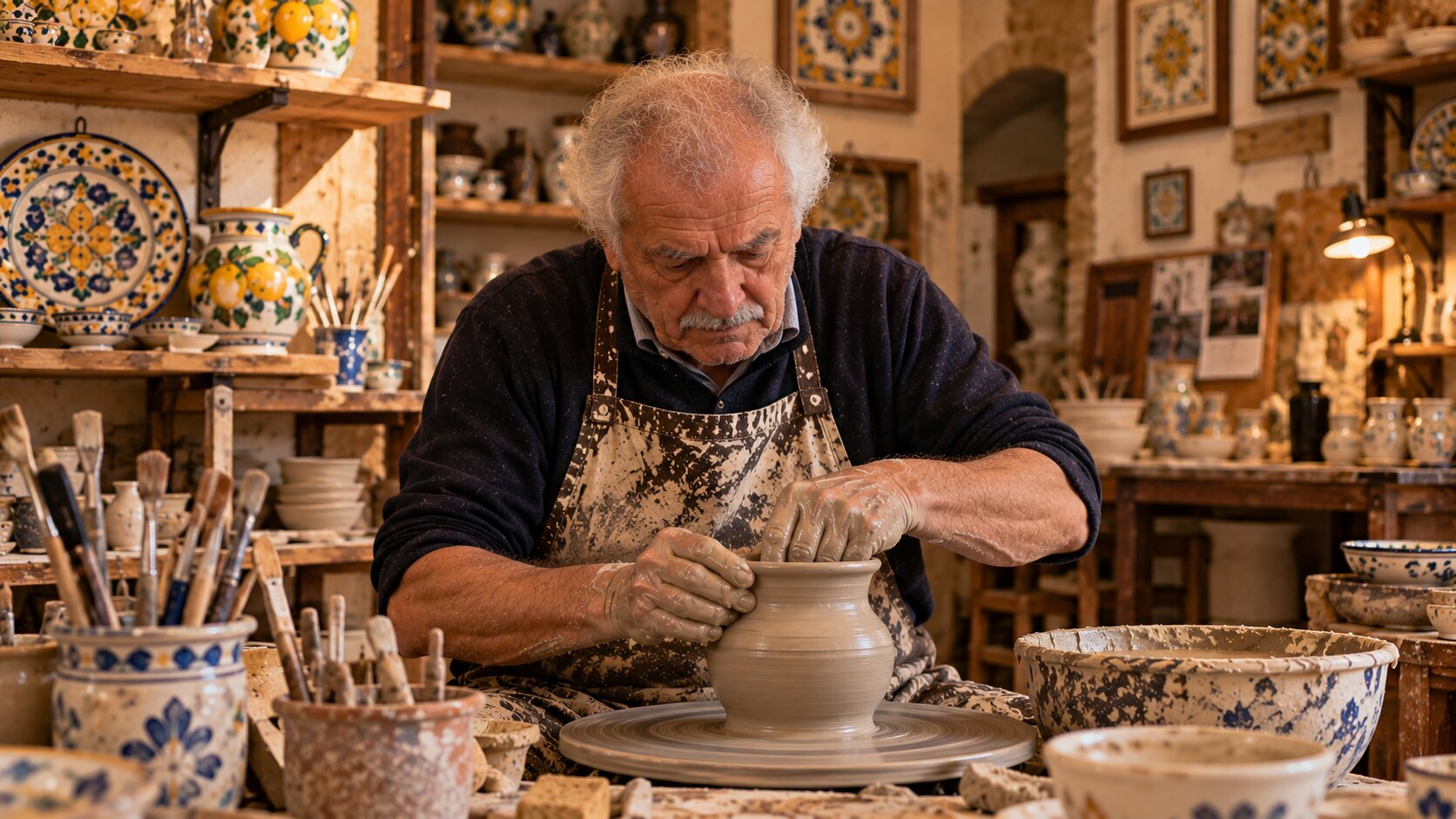
Balducci Ceramica is in Piazza delle Erbe, at the foot of the Duomo's bell tower, on the way up to the Rocca. Franco Balducci and his wife Esther Vogeli opened it in 1990. Franco works at the potter's wheel in the shop itself, so on a good day you watch a piece being thrown while you browse. Esther makes small clay animals and landscape reliefs.
Their pottery is stoneware fired at around 1300°C. That makes it tougher than most decorative ceramics, which matters if you want something you'll actually use in the kitchen. Olive oil cruets and serving bowls are the pieces people tend to carry home.
You may have already seen Franco's work without noticing. The town commissioned two of his ceramic plaques for the Palazzo del Popolo, the town hall on Piazza del Duomo, in 1998. Another sits in Via Folgore opposite the museums. Look for them on your way past.
The Rocca is a few minutes further uphill from the workshop. Our guide to the best views of San Gimignano explains why that climb pays off, and pairing the two makes good use of a short stop.
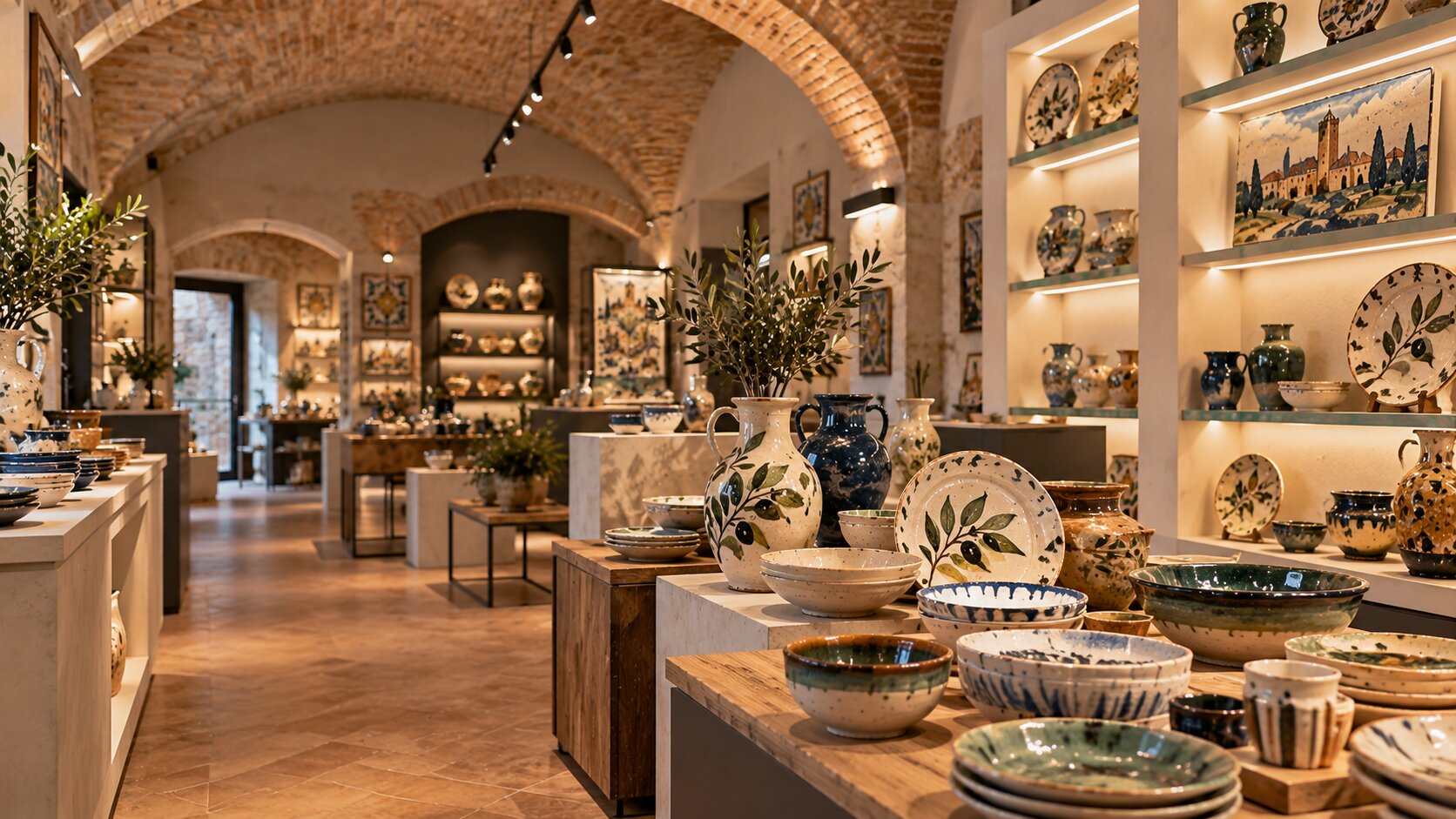
For a different ceramic tradition, Ceramiche Corsini has a shop at Via del Castello 18. The family business started in 1958 and specialises in hand-painted ceramics and terracotta. The painting happens in their main studio in Montespertoli, so here you're buying rather than watching. Still, the pieces are painted by hand, and the style is closer to the colourful painted tableware most people associate with Tuscany.
A whole medieval town, made of ceramic
The strangest craft object in San Gimignano isn't for sale. SanGimignano1300, on Via Costarella, is a small museum built around a ceramic model of the town as it looked around the year 1300.
The scale is 1:100 and the model covers roughly 27 square metres. A team spent three years building it. It reconstructs around 800 buildings, including all 72 tower houses the town once had, plus street scenes with tiny figures. It was conceived by the Rubino brothers, ceramic artisans originally from Capri who had built a business in New York before coming back to Italy.
Only 14 towers still stand today. Seeing all 72 in clay changes how you read the skyline when you step back outside. Entry is paid and the museum has its own shop.
Wood, frames and three generations at the bench
Not every San Gimignano craft is ceramic. Pantani Arte, at Via San Martino 32, is a family woodworking business with roots in the 1930s.
Gino Pantani started as an apprentice in a San Gimignano carpentry shop in the mid-thirties, at about ten years old. In the 1950s he opened his own workshop, making wooden furniture that sold abroad. Later the business shifted to picture frames and painting canvases. Today his sons Alessandro and Massimo handle the creative side, and his daughter Paola runs the commercial end.
It sits away from Via San Giovanni and Via San Matteo, the two streets where most of the foot traffic goes. If you like that quieter side of the town, our piece on San Gimignano beyond the main square covers more of it.
How do you tell a real workshop from a souvenir shop?
A visible workspace is the easiest clue. At Balducci the wheel is in the shop, and Franco is often at it. Ask about a piece and you'll usually hear who made it and how it was fired.
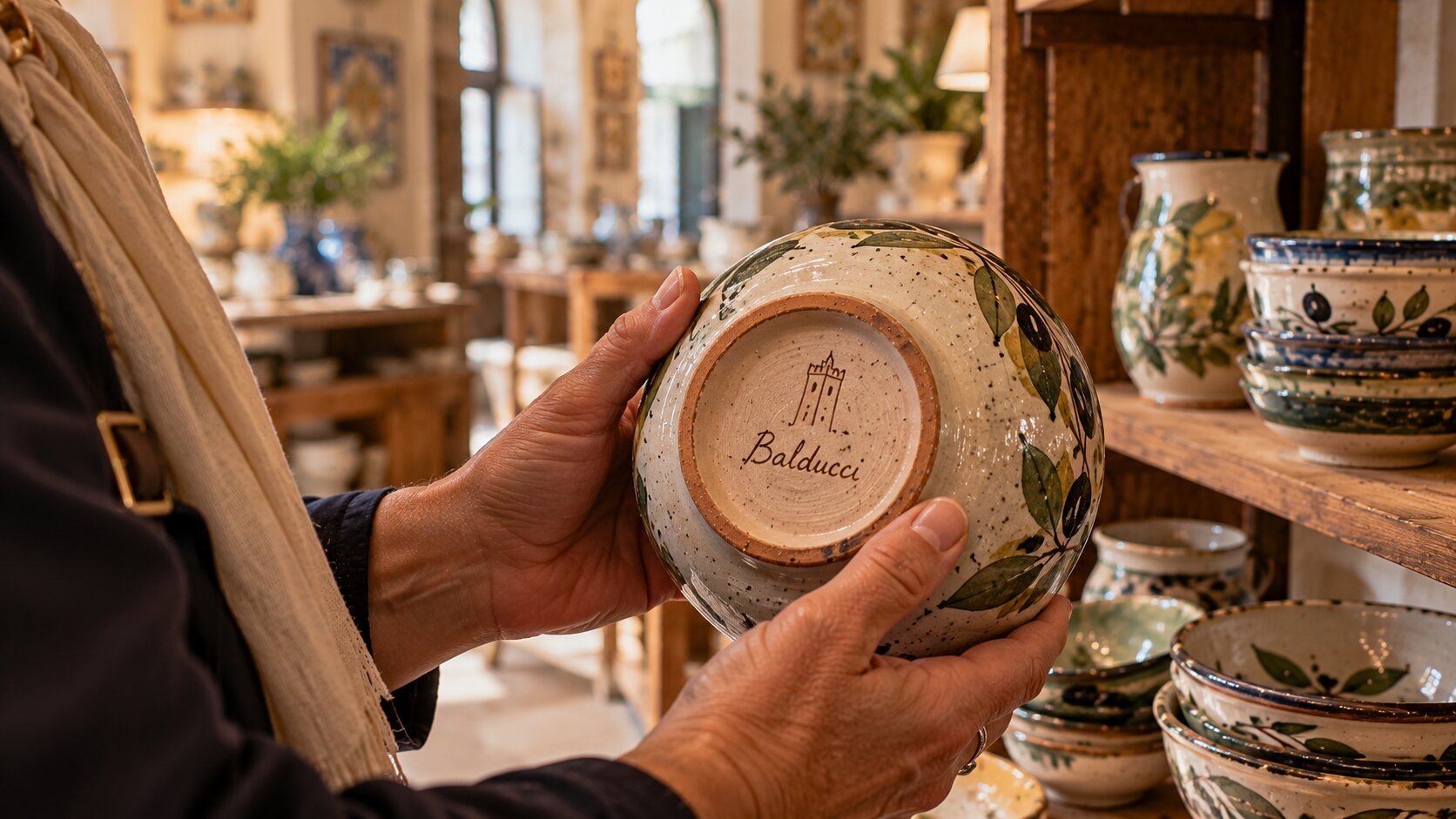
Signatures help too. Many artisans stamp or sign the base of their work, so turn a bowl over before you buy it. Rows of completely identical pieces can be a sign of industrial production, though uniformity alone doesn't prove it. Some small workshops make very consistent series.
Alabaster in a San Gimignano window most likely comes from Volterra, about half an hour away, where the stone has been worked for centuries. Florence has a much stronger historical association with leatherworking than San Gimignano does. Saffron and Vernaccia are local, but they're food and wine, a different subject from the workshops covered here.
Making the most of your free time
On the Best of Tuscany tour, the guided part of the day happens in Siena. San Gimignano is your own time. Before you scatter, your guide hands out a map of the town with a clear meeting point and gives you a time to be back. Plan around that time, not around the shop windows.
Since San Gimignano local crafts are spread across the town, pick one or two workshops before you set off. Balducci and the Rocca sit close together near Piazza del Duomo. Corsini and Pantani take you onto other streets. Trying to cover everything usually means seeing all of it in a hurry, so choose by what you'd actually want on your shelf at home.
Buying something fragile? Think about the rest of the day first. From San Gimignano the coach drives about an hour and a half to Pisa, then you visit the Leaning Tower and the Cathedral before the return to Florence around 8:30pm. Ask the shop to wrap ceramics properly, and check with your guide what you can leave on board during the Pisa stop. For larger pieces, ask the shop whether they ship.
The tour can also be booked without the winery lunch. With that option the estate stop is dropped and more time is spent in San Gimignano, which suits anyone who cares more about the workshops than the tasting.
Bringing a piece of the town home
Balducci's stoneware, Corsini's painted terracotta and Pantani's frames are all made by families who have worked in or around the town for decades. Any one of them fits comfortably into a single afternoon stop.
Our Best of Tuscany day trip from Florence gives you San Gimignano alongside a guided walk through Siena, lunch and wine tasting at an organic Chianti estate, and the Field of Miracles in Pisa. The coach, the timing and the meeting points are handled, so your time in San Gimignano can go where you want it: into its streets and its workshops.