In this post
Pisa history is, for the most part, the story of a port. From around the year 1000 until the late 1200s, the city was one of Italy's maritime republics. It traded and fought across the Mediterranean alongside Genoa and Venice. That money built the cathedral, the baptistery and the Leaning Tower. A naval defeat in 1284 started the decline, and in 1406 Florence took the city for good.
Almost everything people travel to Pisa to see was paid for in those three centuries. Under Florence and the Medici the town gained a university and a grand square or two. It never again had the kind of money that puts up a marble cathedral on open ground.
Paid for by a raid on Palermo
In 1063 a Pisan fleet sailed into the harbour of Palermo, then a Muslim city. The ships broke through the chain that closed it and came home loaded with captured goods. The following year work began on a new cathedral.
Historians didn't have to reconstruct that connection. The Pisans carved it into the building themselves, in inscriptions on the facade that recall the Palermo expedition. The tomb of Buscheto, the cathedral's first architect, is set into the same front wall, in the arch on the far left.
Hardly anyone looks at it. With the tower leaning a few metres away, the bottom corner of the cathedral doesn't stand much of a chance. On The Best of Tuscany day trip from Florence, Pisa is the last stop of the day. You get a short guided walk around the tower, the cathedral and the baptistery, and this is the kind of thing the guide is there for. On your own the facade is old stone and Latin. With someone explaining it, you know what the city was celebrating and what happened to it next.
We went through the square building by building in Piazza dei Miracoli explained. Here the focus stays on the city that paid for it.
Warehouses from Sardinia to Acre
Palermo was one raid. What kept the money coming in was trade. Pisan ships carried crusaders east in 1099, and in return Pisan merchants got streets, warehouses and churches of their own in ports such as Acre, Tyre and Constantinople. Closer to home, the city spent much of the 1100s fighting Genoa over Sardinia and Corsica.
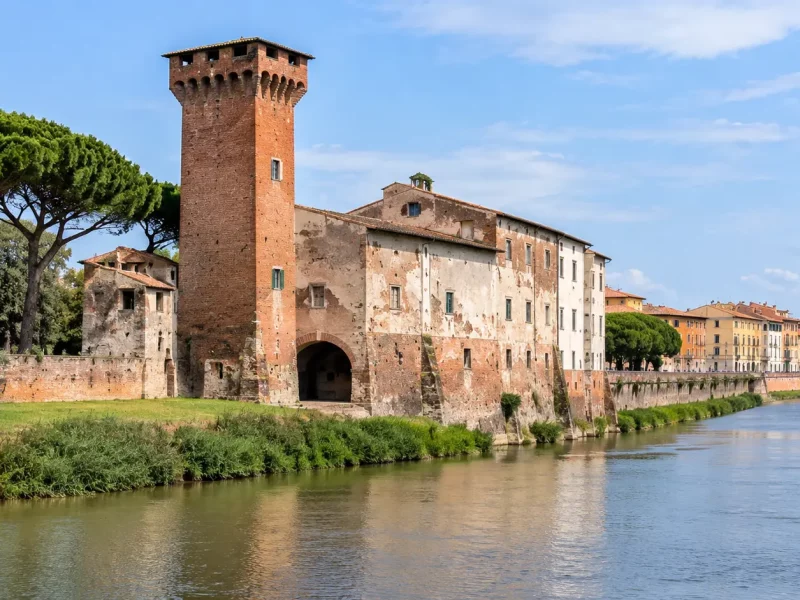
All this from a city that isn't actually on the sea. Pisa sits about ten kilometres inland, on the Arno. Its ships came and went through the mouth of the river and through Porto Pisano, the harbour a little further down the coast. That detail is easy to forget when you're standing in the square, and it explains a good deal of what happened later.
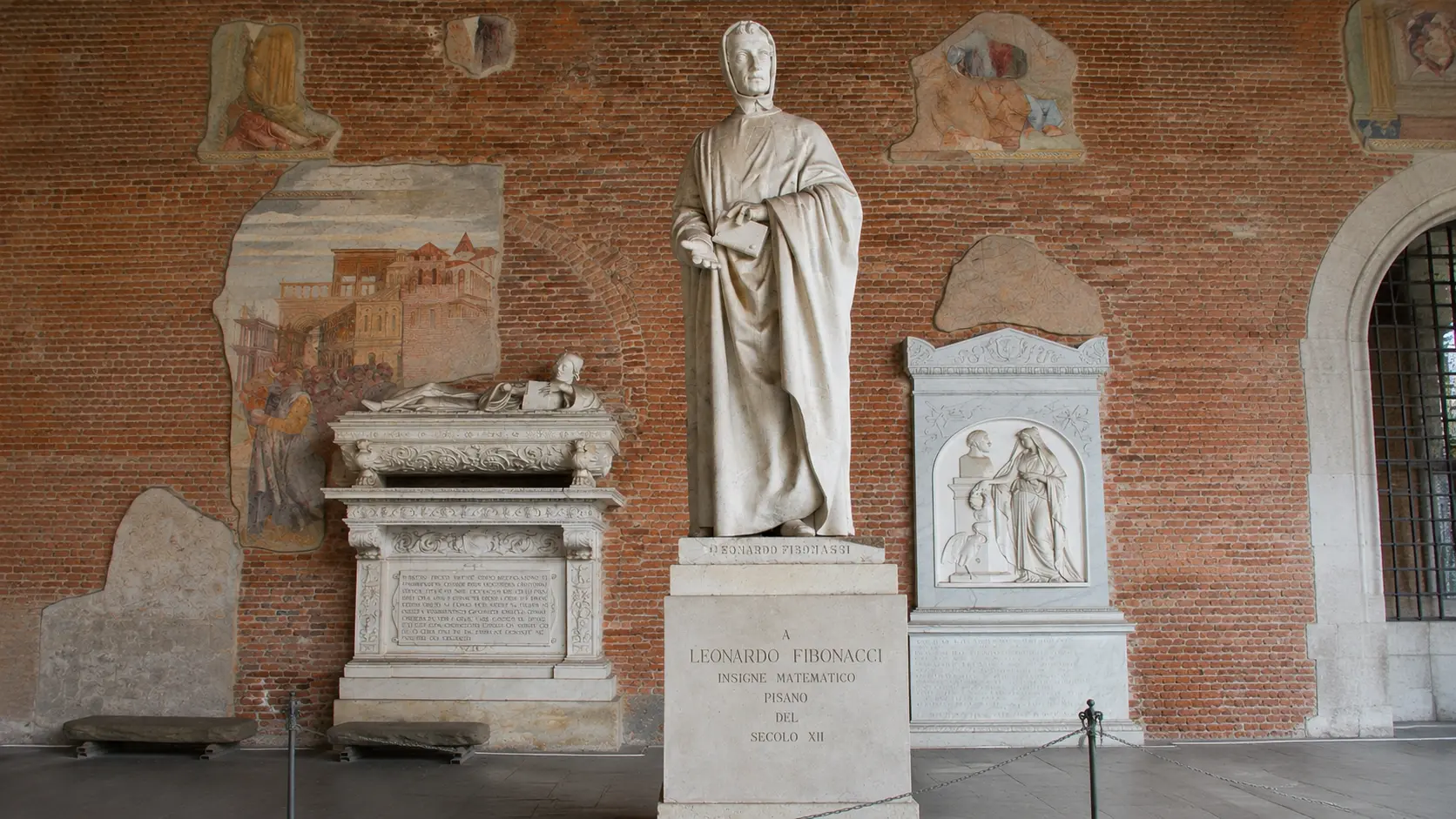
One of the most far-reaching results of all this wasn't a building. In the 1190s a Pisan customs official was posted to Bugia, on the coast of what is now Algeria. He took his son with him, and the young man learned arithmetic from Arab merchants. Back in Pisa, in 1202, he published the Liber Abaci. It taught European merchants to count with Hindu-Arabic numerals instead of Roman ones. Today he is known as Fibonacci.
There is a 19th-century statue of him inside the Camposanto, the monumental cemetery on the north side of the square. Most people walk straight past it, without realising the man behind the famous number sequence was a local.
The city also built its walls in these decades. Work started in 1154 and wasn't finished until 1284, the year of the Meloria defeat. Large parts still stand, including the stretch that closes the Piazza dei Miracoli on its northern and western sides.
And the tower?
Work on the bell tower began in 1173. By the time the builders reached the third floor, the soft ground had already tipped it. Then construction stopped for almost a century, largely because of Pisa's wars. That pause probably saved it, since the soil had time to settle before more weight went on top.
Where Pisa history turns: Meloria, 1284
On 6 August 1284, off the rocks of Meloria near Livorno, the Genoese fleet destroyed the Pisan one. Thousands of Pisans were taken prisoner and held in Genoa for years. A saying went around Tuscany: if you want to see Pisa, go to Genoa.
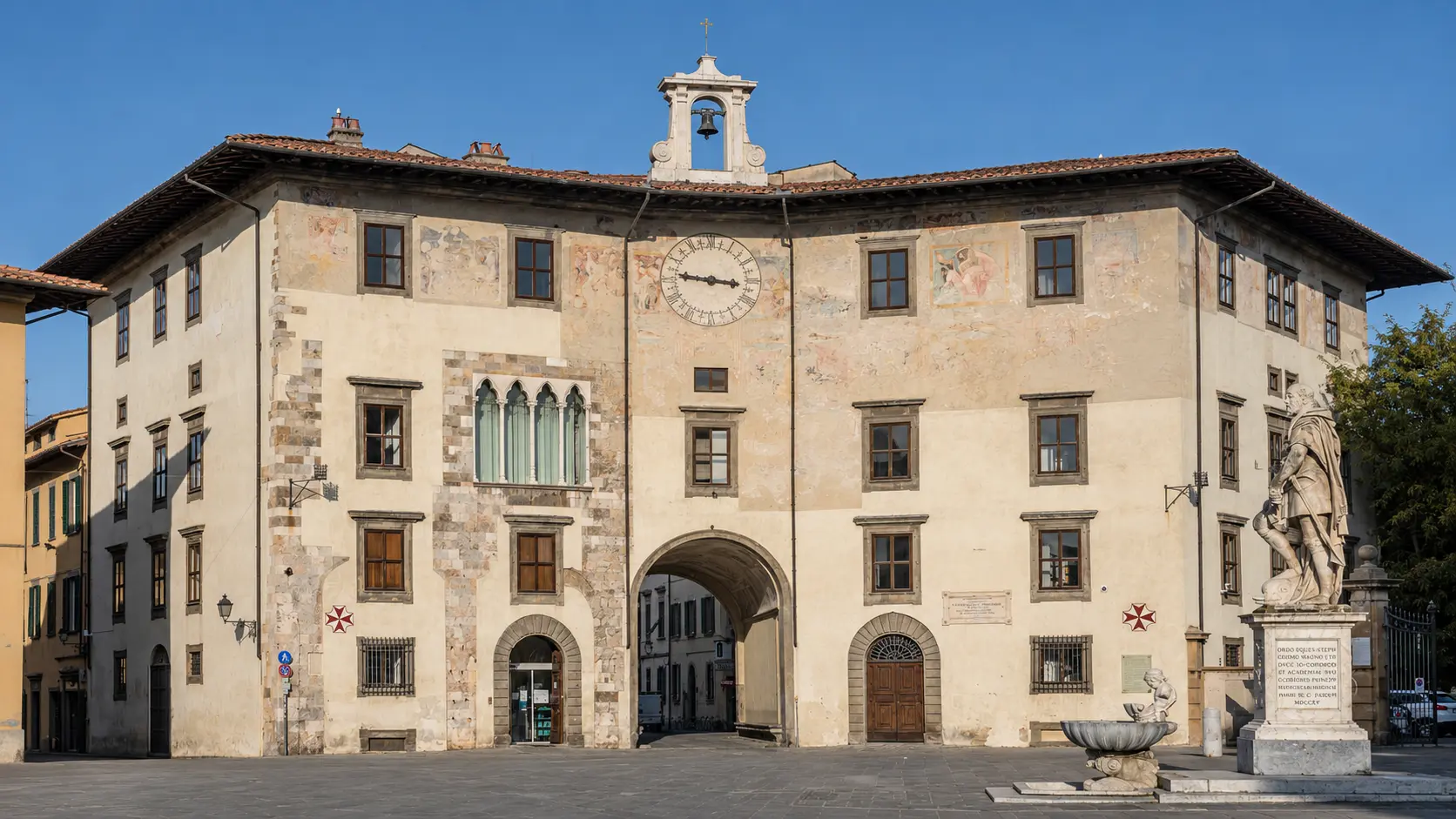
One of the Pisan commanders that day was Count Ugolino della Gherardesca. He came out of the defeat with more power, not less, and ran the city for the next few years. His rivals, led by Archbishop Ruggieri, then accused him of giving castles away to Pisa's enemies. In 1288 Ugolino, two of his sons and two grandsons were locked in a tower on what is now Piazza dei Cavalieri. According to the story, the keys were thrown into the Arno. Early the following year they starved to death.
Dante put Ugolino deep in the Inferno, gnawing on the archbishop's skull, and used the episode to curse the whole city. The tower was later absorbed into the Palazzo dell'Orologio, the building with the clock on the square. Not much of the original is visible.
In 1290 the Genoese came back for the port. They wrecked Porto Pisano and broke the great chain across its entrance, carrying the pieces home as a trophy. The chain hung in Genoa for centuries. It was given back after Italian unification, in 1860. Today the pieces hang on a wall of the Camposanto, a few steps from Fibonacci.
Florence, the Medici and a city of students
Losing the fleet was the first blow. The second was slower. The Arno kept carrying silt to the coast and the shoreline moved out. Bit by bit, the harbour that had made Pisa rich became useless.
Politics didn't help. Pisa was Ghibelline, on the emperor's side, like Siena. That put both cities against Guelph Florence for most of the 1200s and 1300s. For how the two compare as places to visit today, see Siena vs Pisa. Florence besieged Pisa and took it in October 1406. In 1421 it bought Porto Pisano from Genoa, but the silting soon pushed it to use Livorno instead.
Under the Medici, Pisa was given a new job. The university, first founded in 1343, was relaunched by Cosimo I in 1543, and the botanical garden followed in 1544. In 1561 Cosimo founded the Knights of St Stephen, an order meant to fight Ottoman pirates. Giorgio Vasari rebuilt the old civic square as their headquarters. That is Piazza dei Cavalieri.
Galileo was born in Pisa in 1564, studied at the university and came back to teach there in his twenties. The story of the cathedral lamp that gave him the idea for the pendulum is probably a later embellishment. The bronze lamp in the nave today was only made a few years after he is supposed to have watched it swing.
The university is still the thing that shapes Pisa once the day visitors have left. In 1810 Napoleon added the Scuola Normale Superiore, modelled on the École normale in Paris. Its seat today is the Palazzo della Carovana, the old headquarters of Cosimo's knights, on the same square where Ugolino died.