In this post
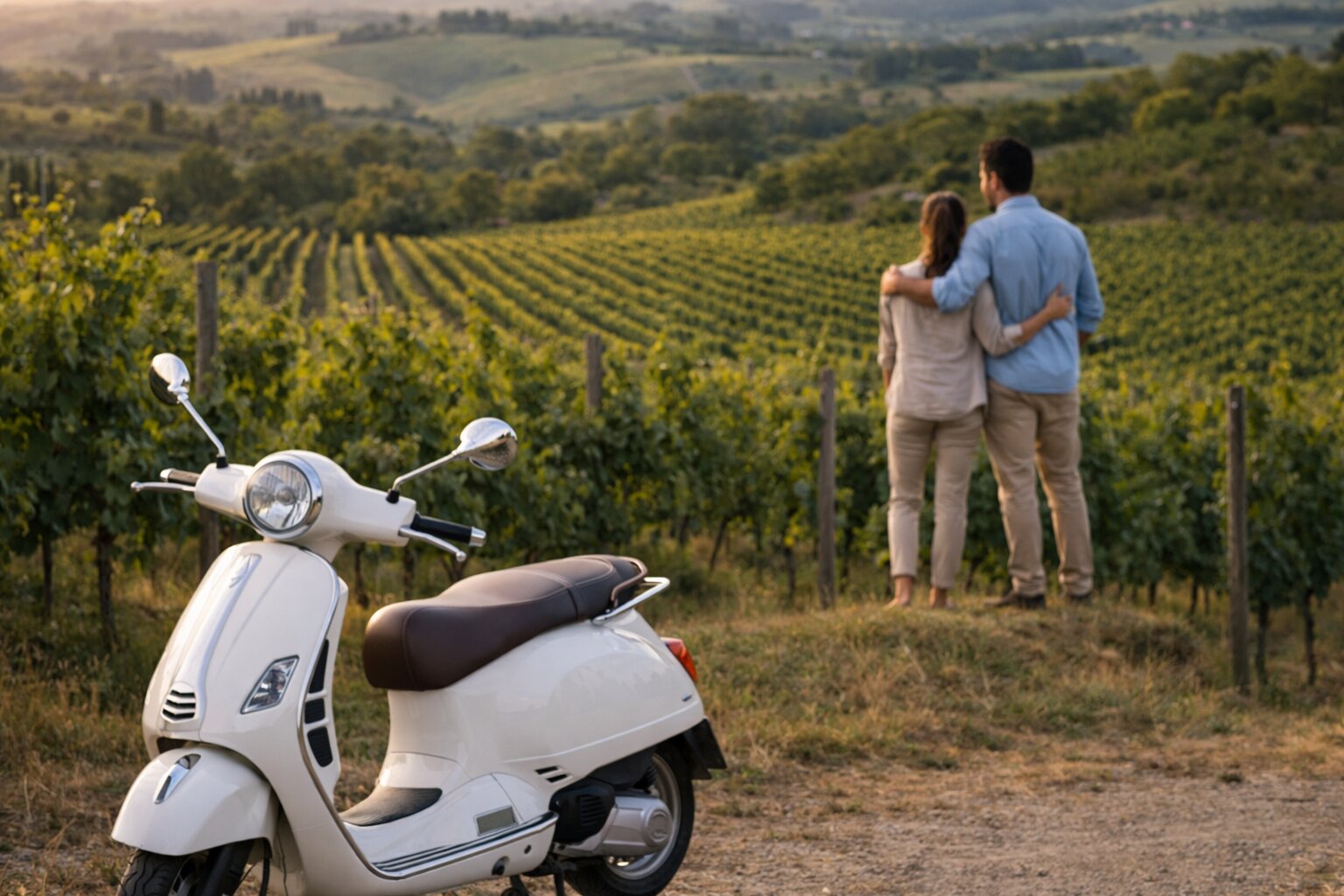
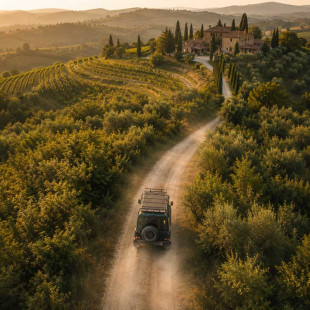
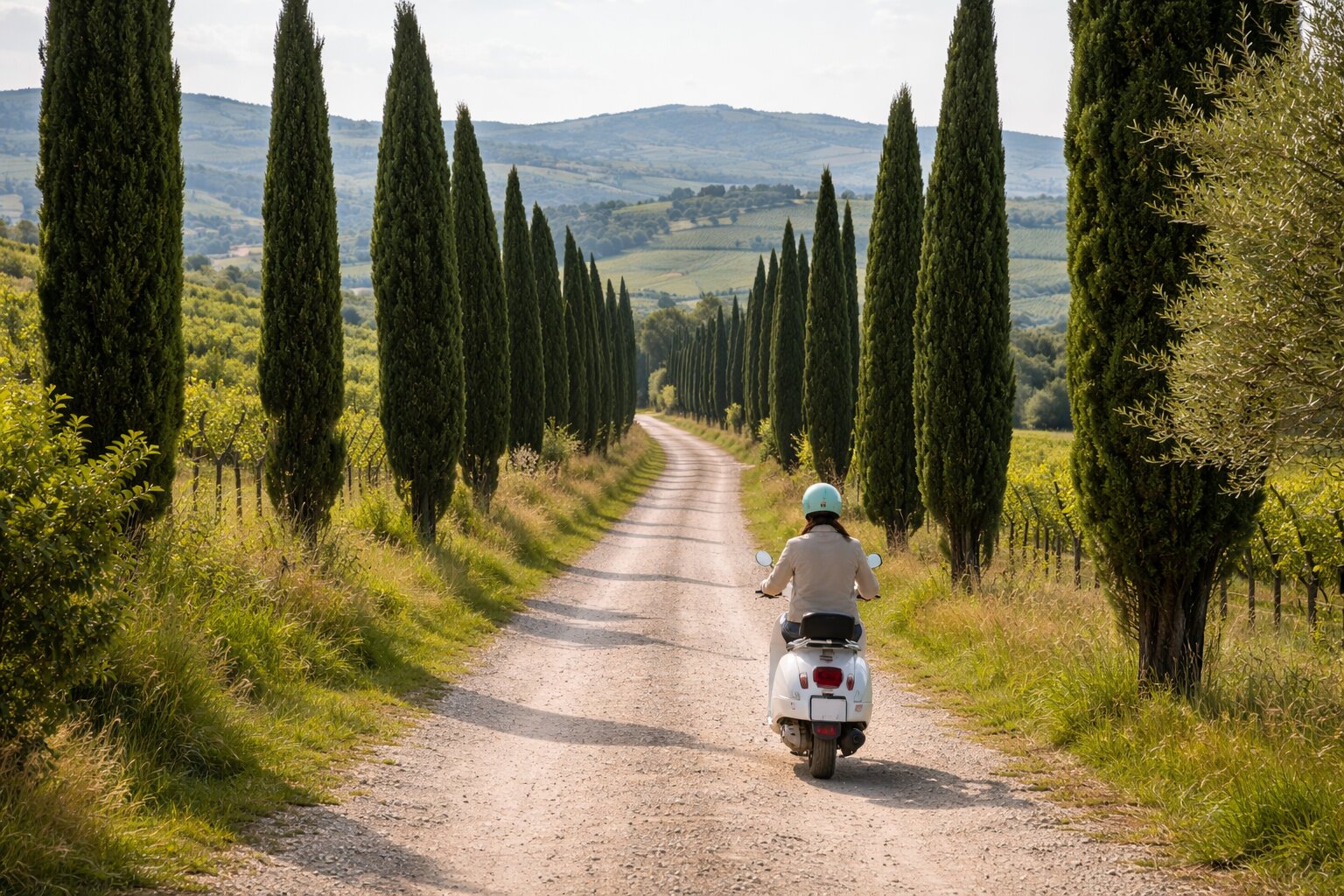
Most people picture Tuscany from a car window or a tour bus seat: rolling hills, vineyards, a village here and there. A Vespa changes that picture completely. You feel the temperature drop as the road dips into a valley. You smell the cypress trees before you see them. You hear the gravel shift under the tires on a strada bianca, one of the unpaved white roads that cut between the vineyards. None of that reaches you through glass.
Private Vespa tours in Tuscany work because they remove the layer that usually sits between traveler and landscape. There's no window, no windshield, no rows of seats between you and the road. You're simply out in it, moving at a pace that lets the countryside register the way it's meant to.
Movement as Experience
The Via Chiantigiana, officially the SR222, runs 69 kilometers between Florence and Siena. It winds through Greve in Chianti, Panzano, Castellina, and Radda before dropping into Siena's hills. On a Vespa, the road stops being a way to get somewhere. It becomes the point of the day.
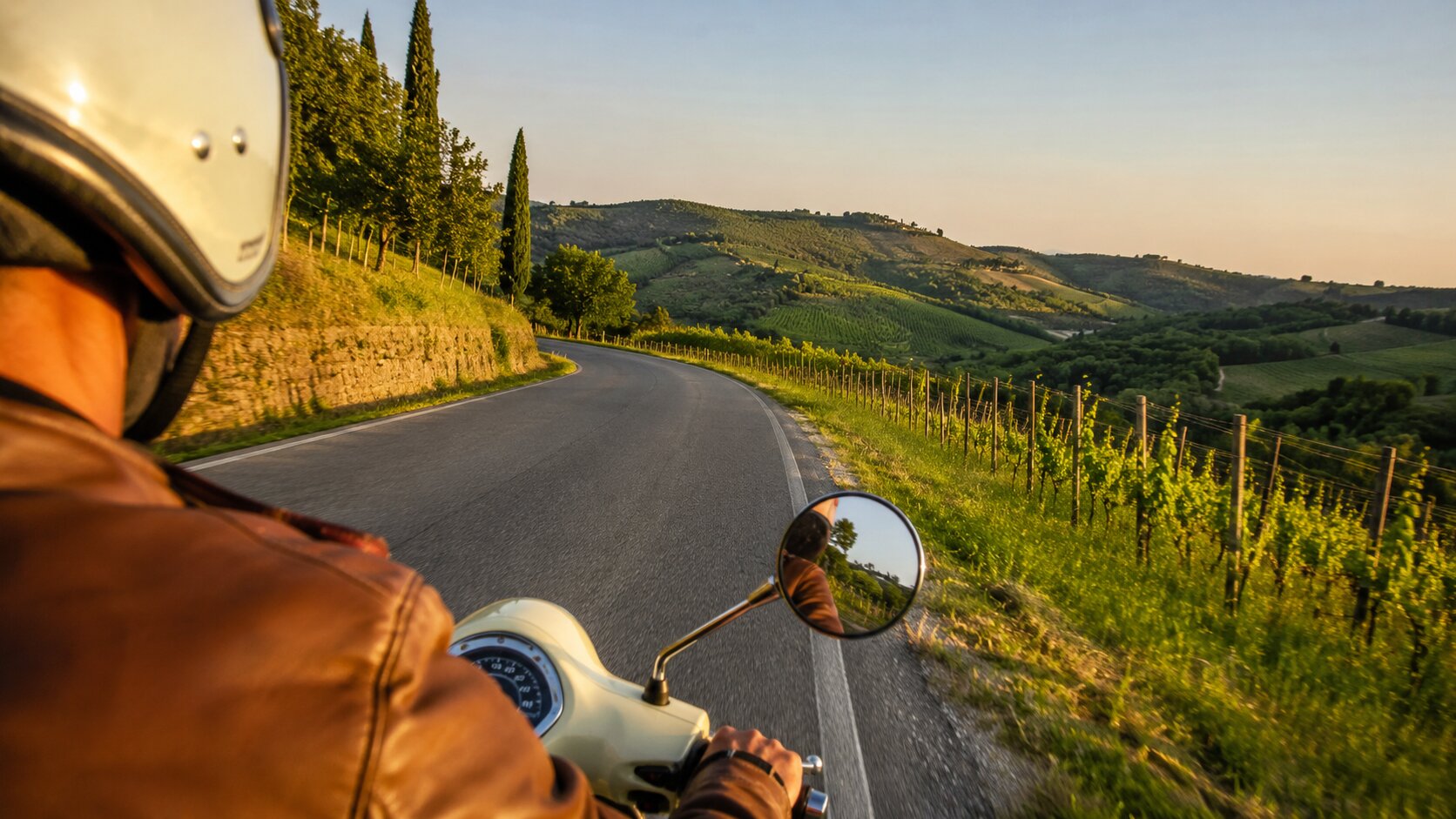
A car keeps you sealed off from the landscape. A Vespa doesn't. You lean into the curves instead of just steering through them. You catch the shift in light as the road climbs out of a cypress-lined stretch into open vineyard. Riders often say the trip feels longer than it actually is, in the best possible sense: more happens per kilometer.
The Vespa's low speed plays a real role here. Most rides stay well under 50 km/h on these back roads, slow enough to notice a hawk circling over a vineyard or an old stone farmhouse tucked behind a row of olive trees. Speed and connection to a landscape tend to work against each other. A Vespa keeps you on the right side of that trade-off.
Why Choose a Private Tour
Group tours run on a fixed schedule. Everyone stops when the guide stops, for exactly as long as the guide allows. A private Vespa tour works differently. If a viewpoint outside Panzano catches your eye, you can pull over and stay for ten minutes or thirty. If a village turns out to be less interesting than expected, you can move on early.
That flexibility doesn't mean the day lacks structure. Your guide still builds a real route, with a clear beginning and end. But the pacing adjusts to you, not to a bus timetable shared with fifteen strangers.
This matters more than it sounds. A couple celebrating an anniversary might want two long, quiet stops instead of five short ones. A photographer might want to chase the light at a specific vista just before sunset. A private tour can absorb both of those requests without disrupting anyone else's day, because there's no one else's day to disrupt.
Beyond the Main Roads
The SR222 gets most of the attention, and it deserves it. But the roads that branch off it are where a private tour earns its price. Take the turn toward Castellina in Chianti, and you can walk the Via delle Volte, a covered medieval passage built into the town's defensive walls, with stone arches shading it from the sun. A few kilometers outside town, Etruscan burial chambers sit underground at Montecalvario, largely ignored by standard day-trip itineraries because a coach can't reach them.
These side roads are often gravel or barely two lanes wide. A tour bus has no business on them. A Vespa does. That's the practical reason lesser-known routes stay lesser-known: most vehicles simply can't take them.
Greve in Chianti offers a similar contrast between the obvious stop and the better one. Most visitors pass through Piazza Matteotti, the town's arcaded main square, take a photo of the statue of explorer Giovanni da Verrazzano, and move on. Fewer detour a few minutes uphill to Montefioralle, a walled hamlet so small it has a single ring road, where the view over the Greve valley opens up without another tourist in sight.
The Role of Guidance
Riding solo through unfamiliar roads sounds appealing until you miss the one turnoff that leads to the best view of the day. A good guide solves that without taking over. They know which stretch of road catches the light best at 5pm, and which village square is worth twenty minutes instead of five.
The guide's job isn't to narrate constantly. It's to shape the day quietly: suggesting a stop here, timing a climb there, so the ride keeps a natural rhythm instead of feeling like a checklist.
Vespa as an Italian Icon
The Vespa isn't just a convenient way to get around Chianti. It carries its own history. Aeronautical engineer Corradino D'Ascanio designed it right after World War II, using techniques borrowed from aircraft construction: a load-bearing body, a wheel mounted like an aircraft's landing gear instead of on a motorcycle fork. Piaggio patented the design on April 23, 1946. Company founder Enrico Piaggio reportedly took one look at the prototype and said, "Sembra una vespa" — it looks like a wasp. The name stuck.
By 1953, the Vespa had become a global symbol, largely thanks to Audrey Hepburn and Gregory Peck riding one through Rome in Roman Holiday. Piaggio built the first Vespa specifically to work on Italy's war-damaged roads: light, easy to repair, and simple enough for someone who had never ridden a motorcycle before. Ride one through the Chianti hills today, and you're using a design that hasn't fundamentally changed in almost 80 years.
A More Personal Way to Explore Tuscany
A private Vespa tour isn't about covering as much ground as possible. It's about how you experience the ground you do cover. The pace slows down. You notice more. And a road you'd otherwise drive past at 100 km/h becomes a place you actually remember.
Most tours run for a half day or a full day, depending on how much of Chianti you want to see. Some riders want Florence's edge and a taste of the countryside in a few hours. Others want the full loop through Greve, Panzano, and Castellina, with a long lunch somewhere in between. A few build the day around a specific stop. A family-run winery for a tasting, or a viewpoint they saw in a photo months before booking the trip, works just as well. Either way works — the itinerary gets built around what you actually want from the day, not the other way around.
For travelers who want that kind of connection to the Tuscan countryside, rather than a list of towns checked off a map, this approach offers something a standard itinerary can't.
Explore this and other unique experiences in Florence to find the right private Vespa tour for your trip.