In this post
The Medici Chapels in Florence are the family's burial complex at the back of the Basilica of San Lorenzo, and most people come for one room: Michelangelo's New Sacristy. It holds seven marble sculptures by his own hand: the two Medici dukes, the four times of day and the Madonna. No other building in the city has more. Before you reach it you walk through a crypt and a huge marble mausoleum, so the best part comes last.
The chapels are also one of the four stops on our small-group Michelangelo Sculpture Tour, together with the Accademia, the Bargello and the Museum of the Opera del Duomo. That combination matters more here than anywhere else on the route. Michelangelo finished the David in his late twenties, while Florence was still a republic. The New Sacristy is the work of a man in his fifties. He was carving tombs for a family he had fought against, in a city he was about to leave for good. A guide who has walked you through the earlier work can show you that change in the marble itself.
Where you go in, and what comes before Michelangelo
The entrance is not inside the church. It's on Piazza di Madonna degli Aldobrandini, behind San Lorenzo, where the market stalls start. The chapels are a state museum, part of the Bargello Museums. Every day people walk into the basilica first and look around for the tombs. The basilica does have a sacristy of its own, which Brunelleschi designed a century earlier. That's why people call Michelangelo's room the "new" one.
The visit starts low, in the crypt Bernardo Buontalenti designed in the late 1500s. Close to fifty members of the family lie down here. Their remains came down from the big tombs upstairs in 1857. The ceilings are low and the light is poor, and most groups move through fairly quickly.
The Chapel of the Princes
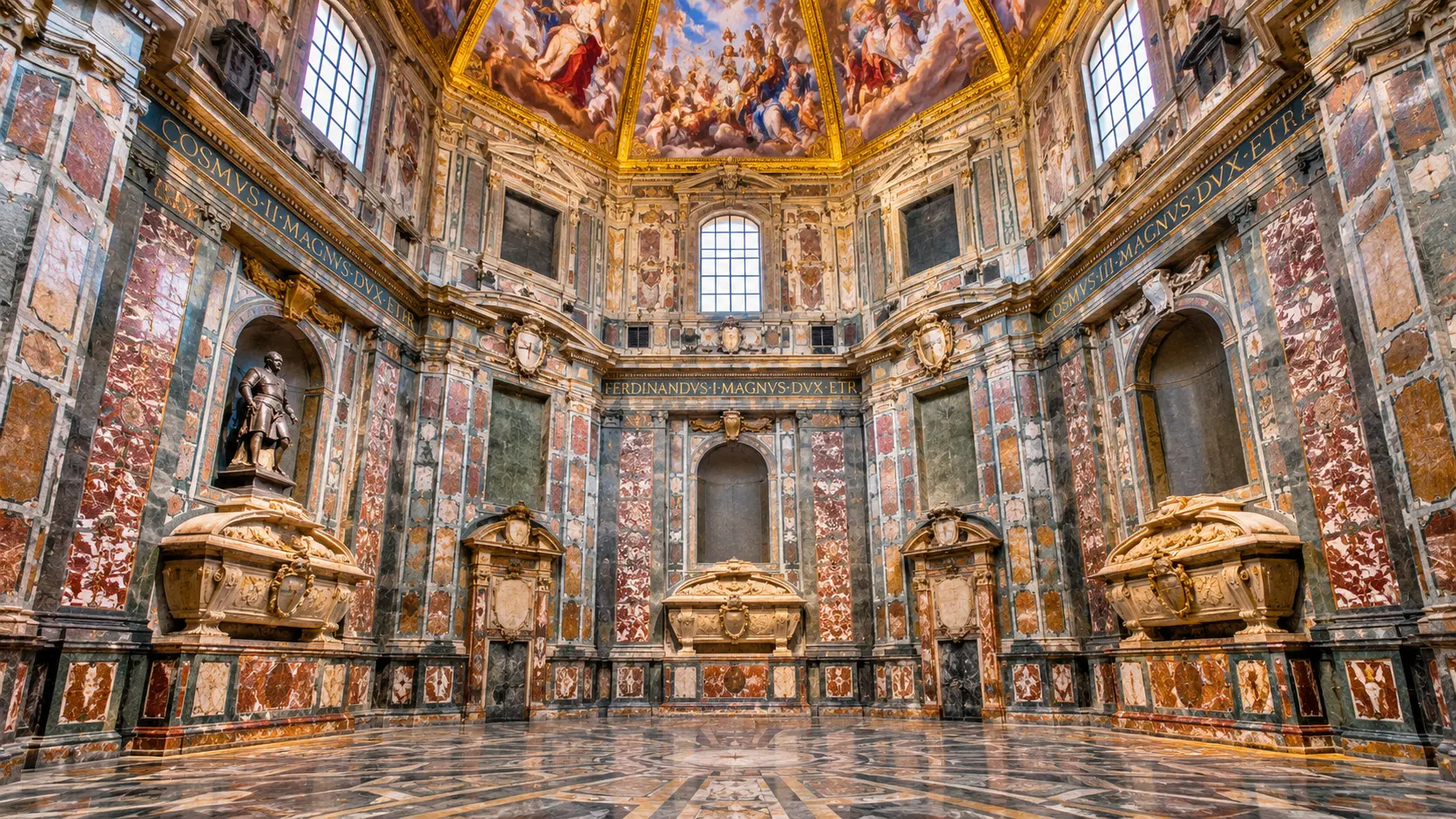
Then you climb into the Chapel of the Princes, which is the complete opposite. Grand Duke Ferdinando I began it in 1604 as a mausoleum for the grand dukes of Tuscany. The architect Matteo Nigetti worked from sketches by Don Giovanni de' Medici. Dark marble and inlaid semi-precious stone cover the walls. The job was so demanding that the grand dukes had set up a workshop for it in 1588, the Opificio delle Pietre Dure. It still exists in Florence today, as a state restoration institute. Around the base you can pick out the coats of arms of sixteen Tuscan towns, all in inlaid stone.
Six grand ducal tombs line the walls, each with a niche above it meant for a bronze statue. Only two niches ever got one, for Ferdinando I and Cosimo II. Painters finished the dome frescoes in the 1830s, long after the last Medici had died. The family wanted this room to show how rich they were, and after the crypt many visitors find it heavy going. To follow the family through the rest of the city, from Palazzo Vecchio to the Pitti, read our guide to Medici sites in Florence.
Michelangelo's New Sacristy
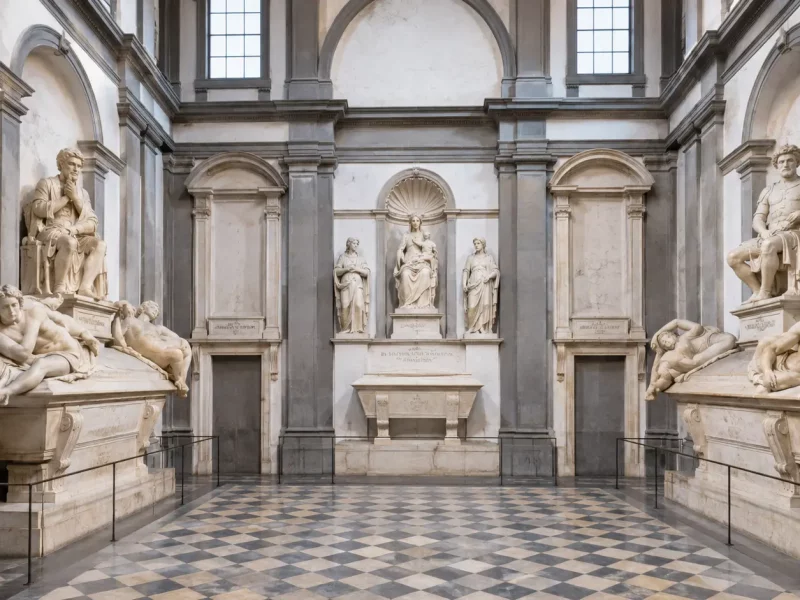
A narrow corridor takes you into a square room of white plaster and gray pietra serena. After the Princes it feels almost cold. Cardinal Giulio de' Medici, soon to be Pope Clement VII, commissioned it in 1520 as a family tomb. Michelangelo designed the architecture and the sculpture together, something he didn't get to do often.
The plan called for four tombs, and only two exist. On one wall sits Lorenzo, Duke of Urbino, chin resting on his hand. Dawn and Dusk recline on the sarcophagus below him. Opposite him is Giuliano, Duke of Nemours, in Roman armor, above Night and Day. Neither duke is a real likeness. The story goes that someone pointed this out, and Michelangelo answered that in a thousand years nobody would know what they had looked like.
Look closely at the faces of Day and Dusk. They're rough, and you can still see the chisel marks. Night, by contrast, has a full polish, with an owl tucked under her leg and a mask at her side. You can see where Michelangelo stopped, and when you know the dates it isn't hard to work out why.
Why the work stopped
In 1527 Florence threw the Medici out, and work on the chapel stopped. Michelangelo sided with the Republic and helped design the city's defenses during the siege that followed. When the family returned in 1530, Clement VII pardoned him and sent him back to the tombs. By then Alessandro de' Medici ruled the city, and the two men had no reason to like each other. In 1534 Michelangelo left for Rome and never lived in Florence again. Years later, on Cosimo I's orders, Vasari and Ammannati set the statues in place. His earlier Florence years appear in our piece on Michelangelo in Florence.
Lorenzo the Magnificent and his brother Giuliano lie here too, in a plain marble tomb on the wall facing the altar. Giuliano died in the Duomo, stabbed during the Pazzi conspiracy of 1478. Above them stands Michelangelo's Medici Madonna. His assistants Montorsoli and Raffaello da Montelupo carved the two saints beside her, Cosmas and Damian. The grand monument the brothers should have had never happened.
Who left the stains on the tomb?
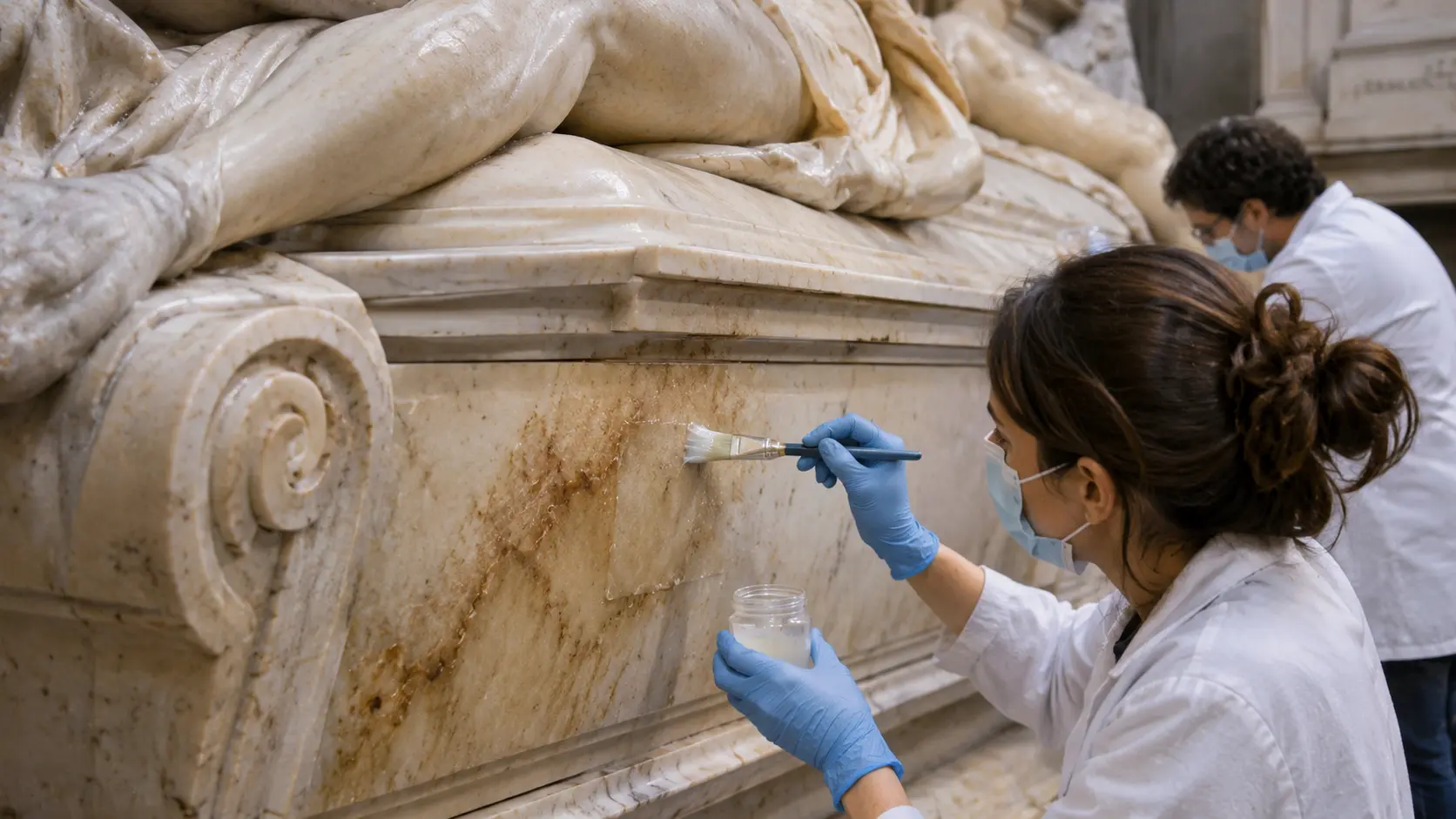
In 1537 Alessandro's cousin Lorenzino murdered him. Alessandro ended up in the sarcophagus of Lorenzo, Duke of Urbino, reportedly without anyone removing his organs first. The team that studied the tomb traced many of the dark stains and small deformations on the marble to his remains. Old glue and plaster had left their mark too.
Starting in late 2019, the museum worked with Italy's National Research Council on an unusual fix. Restorers spread gels carrying bacteria chosen to feed on exactly those residues, among them a strain called Serratia ficaria SH7. They did most of the work in 2020, while the museum had reduced hours. It worked. Monica Bietti, the museum's former director, summed it up for the New York Times: "SH7 ate Alessandro." The marble looks cleaner now than it has in a very long time.
Seeing the Medici Chapels in Florence with a guide
Our tour doesn't try to cover every grand duke in the crypt. Most of the time inside goes to the New Sacristy, because that's where there is the most to read. Which figures did he leave rough? What changed between 1527 and 1534? Why did the room's most important tenants get the simplest tomb? Everyone has a headset, so you can step back to look at Night from across the room and still hear the guide. The tour includes skip-the-line entry and reservations for all four museums.
The tour starts at 9:00 from our office on Via Vinegia, just behind Palazzo Vecchio. It runs in English for a small group. A few things are worth knowing before you book. The museums don't allow large bags, backpacks, umbrellas or liquids. Visitors under 17 need an ID showing their date of birth. Unfortunately the route can't accommodate wheelchair users.
The room under the floor
Below the New Sacristy is a small room, roughly seven meters by two. Paolo Dal Poggetto, then the museum's director, found it in 1975. Charcoal drawings cover its walls, and he attributed them to Michelangelo, although not every scholar agrees. His theory is that Michelangelo hid there for a couple of months in 1530, while the returning Medici hunted supporters of the Republic. Some of the drawings look very like the legs of Giuliano's statue upstairs.
The room first opened to the public in November 2023. Visits need a reservation, a few people at a time for a short stay, and the Bargello Museums publish the current rules and time slots on their website. The standard Medici Chapels ticket doesn't include it, and neither does our tour. If you want to see it, book it separately and as early as you can.