In this post

Florence for kids can look like a hard sell on paper, with the long queues and all those Madonnas. Still, the city has a few places that children enjoy as much as their parents do, and two of them are full of secrets and armour.
If you have children to entertain during your visit to Florence you might like to consider these two colourful and historic places to capture their imagination.
Palazzo Vecchio and its secret passages
At the Palazzo Vecchio in the historic heart of Florence there is the Museo dei Ragazzi, or Family Museum. This imposing palace was built as the office of the Priors, the governors of medieval Florence, and then was transformed into a home by the tremendously wealthy and powerful Medici family. Today it is possible to visit many rooms and even secret corridors of the palace, even though it is still the working office of the mayor and council of Florence.
The secret corridors have a visit of their own, the Secret Passages, meant for older children. It begins with a narrow stone staircase cut into the thickness of the medieval walls. Walter of Brienne, who ruled Florence for a short time in the 1340s, had it built. The story goes that he wanted an escape route. He needed one, too, because the Florentines threw him out after less than a year.
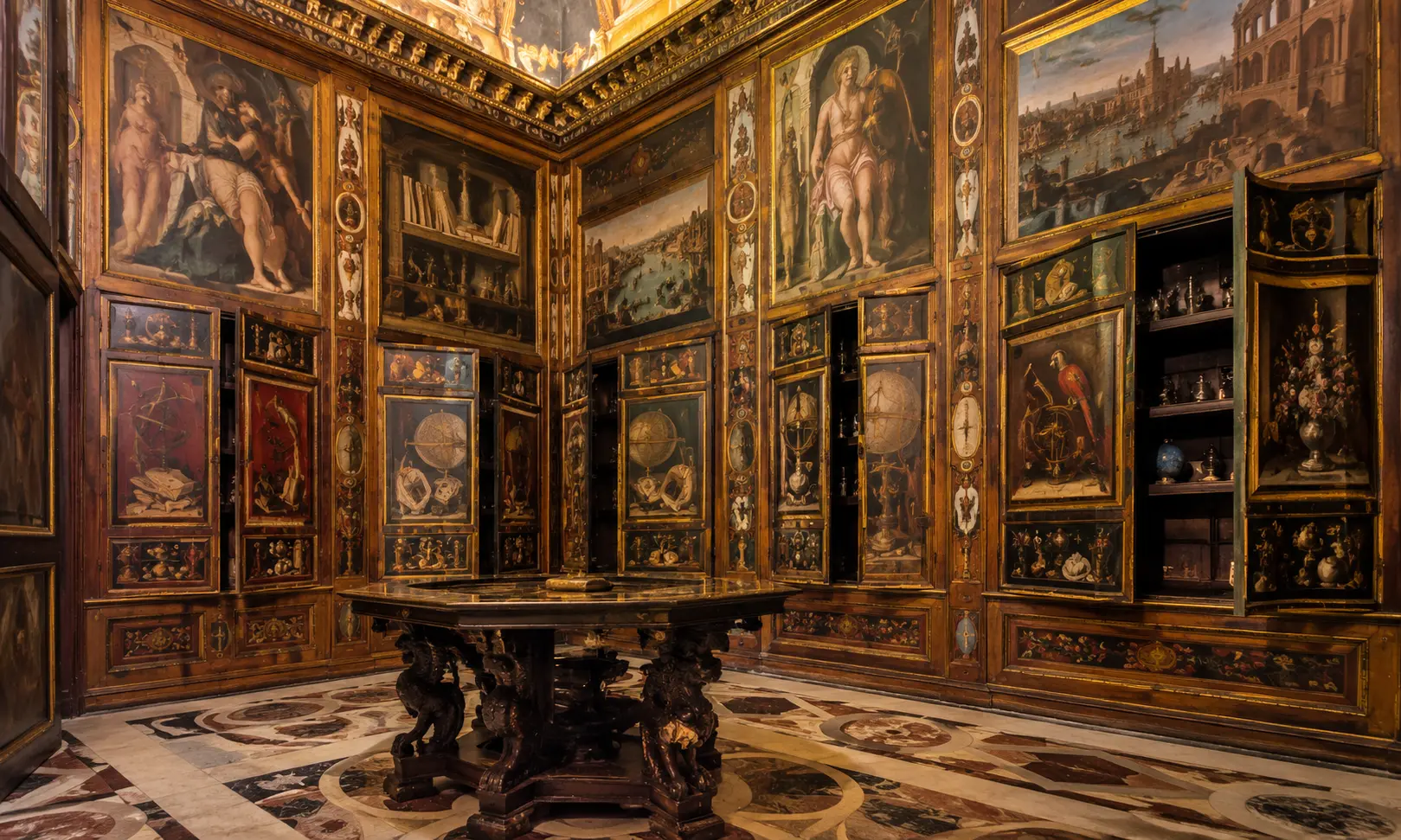
Then comes the Studiolo of Francesco I, a small room with no windows. Its walls are covered in painted panels, and many of them are actually cupboard doors. Francesco was far more drawn to alchemy and science than his father, so he kept his rarest objects here, out of sight. Next door is the Tesoretto, the tiny private study of Cosimo I. The visit also takes you up into the huge timber roof above the Salone dei Cinquecento, and you look down at the beams from the inside.
Visits for younger children
There are guided visits and activities every day, some suited for the 3 to 7 age group and the rest for the whole family. Most of the visits last just over an hour but not all activities are available every day so it's best to book in advance.
Three times a week you can book a guided tour of the Quartieri Monumentali and then enjoy an audience with actors playing Cosimo I or his wife Eleonora di Toledo alternatively there is a guided tour with the architect of the palace, Giorgio Vasari also available three times a week.
With small children we'd pick Life at Court. Cosimo I and Eleonora di Toledo lived here with their eleven children, and the visit follows the family through their rooms, from the banquets in the great hall to the terraces they planted like gardens. Children over eight can also try the fresco painting workshop, and then look at the frescoes on the walls with rather different eyes.
Palazzo Vecchio Museum opening hours: April-September daily 9am-midnight except Thursday 9am-2pm. Winter months daily 9am-7pm except Thursday 9am-2pm. Extended opening for public holidays except closed Christmas Day.
Admission: € 6.00 Concessions available.
The Stibbert, a house full of armour
A short taxi ride or the city bus number 4 from the train station will take you to the Museo Stibbert, once the private home of a wealthy Florentine.
Frederick Stibbert inherited a fortune when he was only twenty one. His grandfather had been the British Governor of Bengal, his father a Colonel in the Coldstream Guards who had married an Italian and chosen to settle in Florence. Although he inherited a fortune, he was a clever and careful investor and managed to increase his wealth all through his life allowing him to follow his passions for travel and collecting.
Knights on horseback in the living room
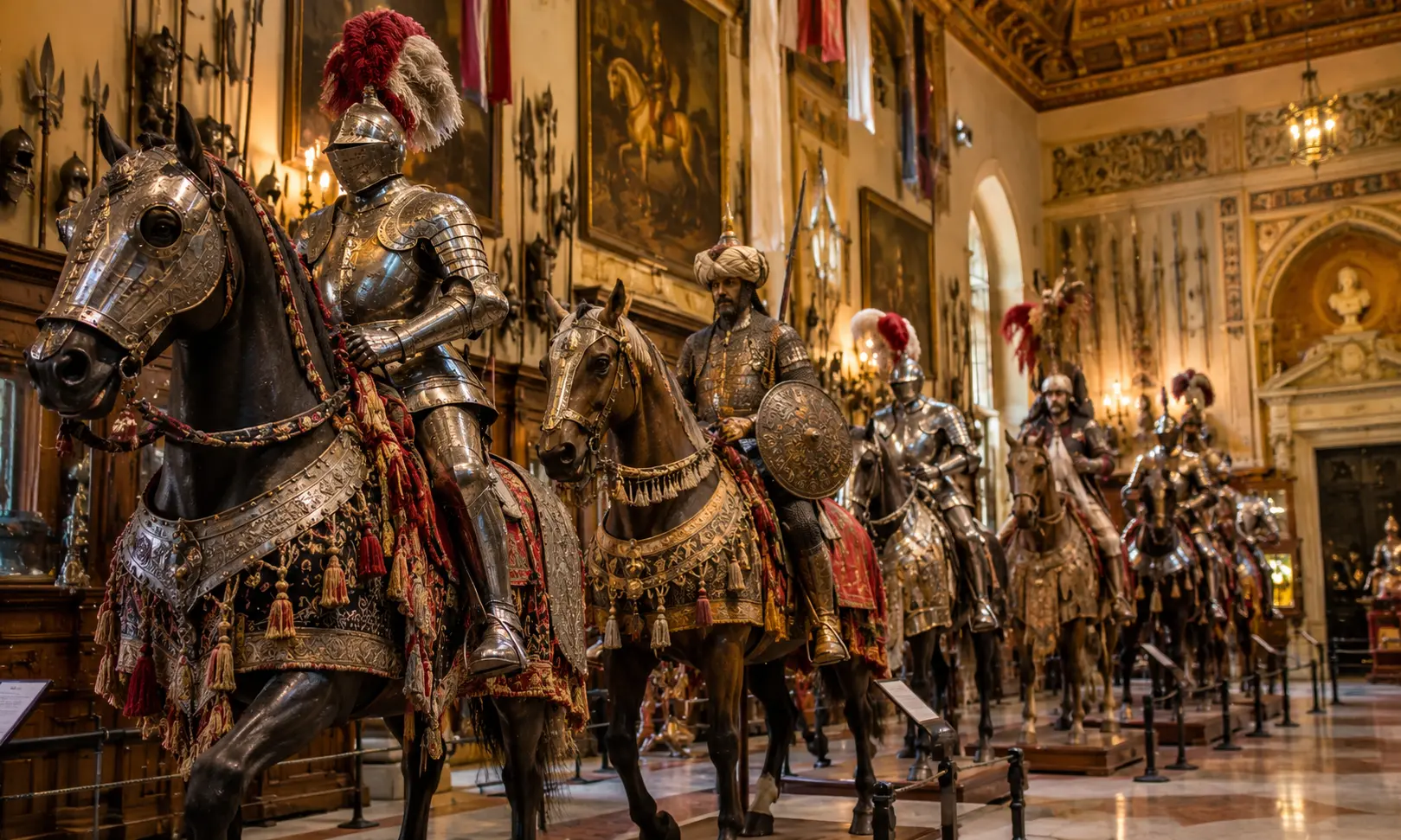
For nearly fifty years he filled his home with his finds from ceramics to paintings, from clothing to arms. The most famous collections within the fifty thousand pieces are those of the European, Oriental and Japanese armour, many displayed on life size models, some on horseback, in one of the main rooms of the house. The fascinating thing to remember is that they were not placed there when the house was opened to the public as a museum, but they were part of the furnishing of Stibbert's home; the rooms are arranged as he lived in them and as he left them when he died in 1906.
That main room is the Sala della Cavalcata. European and Ottoman knights sit on their horses in full armour, lined up as if they were about to ride out. Stibbert had local craftsmen make the figures inside the armour, so they look like people and not like stands. Elsewhere in the house there's a Moorish room, its floor tiles made by the Cantagalli workshop in Florence and its design borrowed from the Alhambra in Granada.
Samurai upstairs, a garden outside
The Japanese rooms are on the top floor, up a spiral staircase, so leave the pushchair below. They hold samurai armour, swords and helmets, and it's one of the largest collections of its kind outside Japan.
The house sits on the hill of Montughi, north of the centre, well away from the crowds around the Duomo. Stibbert turned the grounds into a romantic English park, with pavilions, fake ruins, a pond and a small Egyptian temple. He travelled to Egypt after the Suez Canal opened in 1869, painted watercolours there and brought back pieces for the temple. After an hour of swords and helmets, it's where children can run about. The museum runs family visits as well, though only once a month.
Museo Stibbert - Via Frederick Stibbert, 26. Opening hours: 10am-2pm Monday-Wednesday; 10am-6pm Friday-Sunday. Closed January 1, Easter Sunday, May 1, August 15 and Christmas Day.
Admission: € 10:00 Concessions available. How to get there: Ataf bus number 4 - Bus stop: Gioia
Planning Florence for kids around one big visit
With young children, one of these two places in a morning is enough. They don't share a morning well anyway, since Palazzo Vecchio stands on Piazza della Signoria and the Stibbert is out on its hill. Spend the afternoon outdoors or at the table instead. If your dates are flexible, the cooler months also make Florence for kids a lot easier, with shorter queues and parks you can actually sit in.
For lunch, the upstairs food hall at the Mercato Centrale suits fussy eaters, since everyone can choose from a different counter. There's more on it in our piece on what to see at the Mercato Centrale. An artisan workshop in the Oltrarno is another good pause between museums: a leather worker or a gilder at the bench is real work you can watch from a couple of feet away. Our article on a private Florence tour with artisan workshops describes that kind of visit.
Florence for kids doesn't need much planning, but if you'd rather not do it yourself, one of our private walking tours with a local guide can be shaped around your children's ages and a lunch stop.